| Previous Story: Planet Of The Spiders | Next Story: The Ark In Space |
| Next in Production: The Sontaran Experiment |
|
Serial 4A · Classic
Series Episodes 382 – 385: Robot
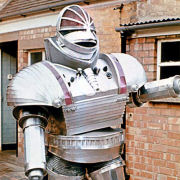
The secret plans for a disintegrator gun are stolen under seemingly impossible circumstances. When a spate of further robberies targets the components needed to construct the weapon, the newly-regenerated Doctor is summoned to help UNIT investigate. Meanwhile, Sarah has become suspicious of Think Tank, a scientific collective with ties to a fascist political organisation. Sarah discovers that Think Tank is in possession of a massive robot designed by an estranged member, Professor Kettlewell. When the Doctor grows suspicious that the robot has perpetrated the thefts, he becomes its next target.
As Doctor Who's eleventh production block neared its conclusion in early 1974, the programme was in a state of flux. Planet Of The Spiders marked the end of Jon Pertwee's tenure as the Doctor and served as the final serial of Season Eleven. However, the recording block would continue with the Fourth Doctor's introductory adventure, which would be held over to start Season Twelve. Outgoing script editor Terrance Dicks, who was stepping down from his post with Pertwee's swansong, saw this as an opportunity to quickly secure a commission now that he had returned to freelance writing. Dicks convinced his successor, Robert Holmes, that Doctor Who had a tradition of departing script editors being commissioned by their replacements. Holmes was interested in a story which considered how an advanced, autonomous computer intelligence might behave. Inspired by the 1933 film King Kong, Dicks was keen to write about an oversized, sympathetic monster. The synthesis of these two notions became known as Robot. For the scenes in which Sarah infiltrated a meeting of the Scientific Reform Society, Dicks drew heavily upon The Mauritius Penny, a 1962 episode of The Avengers he had co-written with Malcolm Hulke. Dicks incorporated several hallmarks of the Pertwee era into his scripts to reassure audience members who might be wary of the new lead actor. These included the Doctor's roadster, Bessie, and United Nations Intelligence Taskforce (UNIT) regular characters Brigadier Lethbridge-Stewart and Benton -- the latter now promoted to Warrant Officer so that he could replace Captain Mike Yates as the Brigadier's second-in-command.
Because he was in the process of stepping down as a BBC staffmember, Dicks' formal contract to write Robot wasn't issued until May 23rd. However, he actually began working on it several months earlier, at a time when the new Doctor had yet to be cast. To this point, Dicks and producer Barry Letts -- who would himself be leaving Doctor Who at the end of the recording block -- had envisaged an older actor for the role. As such, they decided to create a new companion who could handle the physical aspects of the Doctor's adventures, in the vein of Sixties characters such as Ian Chesterton and Jamie McCrimmon. Robot would therefore introduce Surgeon Lieutenant Harry Sullivan; the surname Sweetman may also have been considered. Although UNIT was being gradually deemphasised as a focal point of the Doctor Who format, Harry would still be attached to the organisation, providing an ongoing element of familiarity for sceptical viewers. To play Harry, Letts cast Ian Marter, who had already appeared in 1973's Carnival Of Monsters and who had been Letts' original choice for Mike Yates. Marter and Sarah Jane Smith actress Elisabeth Sladen were both issued twenty-six-episode contracts on April 16th. The next day, Nicholas Courtney and John Levene were booked to play Lethbridge-Stewart and Benton in Robot. By this stage, however, the “elderly Doctor” concept had been discarded and forty-year-old Tom Baker cast in the lead role, undercutting Harry's narrative function. The development of the Fourth Doctor's character proceeded in earnest throughout the month of March. Doctor Who's incoming producer, Philip Hinchcliffe, worked closely with Holmes and Baker in formulating the actor's approach to the role. It was ultimately agreed that Baker would play the Doctor as more of an eccentric than Pertwee's dashing man of action. He would play up the fact that, as an alien, the Doctor's thought processes and reactions could sometimes be a departure from the human norm. Drawing upon the bohemian characteristics towards which both Baker and Letts were inclined, costume designer James Acheson assembled an outfit for the new Doctor which unconsciously echoed the 1892 Aristide Bruant lithographs of French artist Henri de Toulouse-Lautrec. One of the elements inspired by Toulouse-Lautrec was a scarf, and Acheson secured the services of an elderly woman named Begonia Pope to knit it. Misunderstanding Acheson's instructions, Pope used all of the wool he had supplied, resulting in an inordinately long piece of neckwear. Baker, however, liked the image this conveyed and, although its length was eventually reduced, it was agreed that the scarf could be incorporated into the on-screen action and make an effective prop. The director assigned to Robot was Christopher Barry, whose last Doctor Who work had been on The Mutants two years before. Unusually, Barry elected to conduct all of the location recording on videotape, rather than film. This would better facilitate the chroma key technique, which would be used to achieve the effect of the “giant” robot in Episode Four. All of the exterior shooting was conducted at the BBC Engineering & Training Centre at Wood Norton, near Evesham, Hereford and Worcester. The Doctor Who team spent seven days there, from April 28th to May 2nd, as well as May 5th and 6th. On the last day, Barry was frustrated by Letts' insistence that he achieve the Robot's attack on the UNIT tank by placing an Action Man toy in the foreground and having it vanish via roll-back-and-mix -- an effect which proved unsuccessful. Barry had reserved May 7th as a spare day in case his schedule was upset by an ongoing dispute between the BBC and its scene shifters, but it does not appear that this was required. However, the dispute had larger consequences for the studio recording, which was due to begin with a two-day session on May 21st and 22nd in BBC Television Centre Studio 3 at White City, London. Barry's intention was to complete all of the material from the first two episodes during this block. However, the industrial action resulted in the cancellation of the first recording day, and limited the shots Barry could achieve on the second day. He wound up taping sequences set in the vault for Episode One, plus Episode Two scenes in the Thinktank workshop and Kettlewell's laboratory. Even the latter was compromised to an extent: a stepladder left on the set could not be moved without potentially angering the union, forcing Barry to shoot around it. The situation also meant that the Doctor Who sets could not be struck after recording had wrapped; consequently, the next day's episode of Blue Peter was taped on them as well. Fortunately, Letts was able to reschedule the entire studio session for June 1st and 2nd, again in TC3; by this time, the situation with the scene shifters had been resolved. Episode One was recorded on the 1st, alongside the first five scenes of Episode Two. The remainder of the second installment was completed on the 2nd, together with the opening scene of Episode Three. Most of the material which had been attempted on May 22nd was remounted, although some footage survived to the broadcast programme . The concluding studio session for Robot then went ahead in TC3 as scheduled, on June 6th (for the remainder of Episode Three, plus Episode Four sequences in the control room and the corridor) and 7th (for the rest of Episode Four). This brought Doctor Who's eleventh production block to a close, and marked the point at which Hinchcliffe formally took over from Letts.
Nonetheless, Letts continued to offer input on Robot and, during editing, he and Barry became unhappy with some of the chroma key sequences. A remount was eventually scheduled for October 24th in TC7, with Elisabeth Sladen and Michael Kilgarriff reprising some of the scenes featuring Sarah and the Robot. Hinchcliffe, meanwhile, decided to save money by avoiding a complete redesign of the Doctor Who title sequence, which had just been revamped the year before. Instead, he asked Bernard Lodge of the BBC's Graphics Department to make only minor changes, replacing Pertwee's profile with Baker's and incorporating an image of the TARDIS. On December 28th, the amended credits heralded the start of Season Twelve, and of the Tom Baker era as a whole. Episode One was scheduled for 5.35pm, with the remaining installments sliding back to 5.30pm. Since the conclusion of Planet Of The Spiders, the Doctor Who timeslot had generally been filled by We Want To Sing during the summer and the Star Trek animated series in the autumn. Doctor Who was now preceded by The Shari Lewis Show, as well as a news update; it led into Bruce Forsyth And The Generation Game. The new Doctor's debut attracted a large audience of 10.8 million viewers -- but, all the same, few could have suspected that they were witnessing the start of Doctor Who's transformation from a stalwart of British television into a worldwide cult phenomenon...
|
|
|||||||||||||||||||||||||||||||||||||||||||||||||||||||||||||||||||||||||||||||||||||||||||||||||||||||||||||||||||||||||
| Updated 23rd September 2023 |
| Return To | ||
|---|---|---|
| Main Page | Episode List | Season 12 |
| Previous Story: Planet Of The Spiders | Next Story: The Ark In Space |
| Next in Production: The Sontaran Experiment |