Serial M · Classic Series
Episodes 54 – 57:
The Romans
Whilst vacationing in AD 64 Rome, Ian and Barbara are kidnapped and sold
as slaves. Ian ends up on a doomed galley ship, while Barbara becomes a
handmaiden in Nero's palace, pursued by the lusty Caesar himself.
Meanwhile, the Doctor and Vicki are travelling to Rome, unaware of their
friends' plight. On the road, they discover the body of a murdered
musician named Maximus Pettulian. The Doctor decides to investigate by
masquerading as Pettulian, unaware that he is embroiling himself in a
conspiracy against Nero -- and in the events which culminate in the
Great Fire of Rome.
The idea of setting a Doctor Who story in Roman times had been
under consideration at least as early as the spring of 1964. On April
14th, a document was issued which outlined possible adventures should
Doctor Who proceed to a second recording block; the penultimate
serial, to consist of four episodes, was described as “Past”
and “Roman”. On August 31st, Dennis Spooner was commissioned
to write The Romans, though it's unclear whether this was spawned
from the production team's earlier plans, or was an independent
creation. By this point in time, Spooner -- having recently completed The Reign Of Terror -- had been appointed the
successor to David Whitaker as Doctor Who's story editor, although
the post would not officially change hands until October 31st. With a new
companion, Vicki, being introduced in Whitaker's The
Rescue, it was agreed that The Romans should follow it into
production so that Spooner could help define the character.
Now that Doctor Who was well-established, producer Verity Lambert
was keen to test the boundaries of its format. Aware of Spooner's
humorous tendencies, she suggested that The Romans might be an
appropriate venue to attempt a comedic Doctor Who story.
The original idea was to spoof the 1951 film Quo Vadis, in which
a Roman commander's love for a Christian woman brought him into conflict
with Emperor Nero. Spooner soon modified his approach after discovering
that Carry On Cleo -- the latest entry in the Carry On
film franchise, which would be in theatres shortly before The
Romans started airing on television -- was also being designed as a
Quo Vadis parody. Nonetheless, he retained the idea of setting
his scripts at the time of the Great Fire of Rome.
Dennis Spooner eschewed historical accuracy in favour of
popular myth
Whereas previous Doctor Who historical adventures had paid often
scrupulous attention to an accurate portrayal of events, Spooner
eschewed this approach in favour of embracing popular myth. The real
inferno burned over nine days in July of the year AD 64. It left ten of
Rome's fourteen districts partially or completely destroyed; amongst the
structures which fell to the blaze was Nero's palace, the Domus
Transitoria. According to the historian Tacitus, Nero was in Antium when
the fire broke out, and blamed the disaster on the widely-persecuted
Christian sect. However, it was popularly rumoured that Nero had
engineered the holocaust in order to rebuild Rome to his own design; in
particular, he soon embarked on the construction of a mammoth new
palace, the Domus Aurea or Golden House. The legend of Nero fiddling
while Rome burned appeared in no historical account, although both
Tacitus and Suetonius reported stories of the Caesar singing during the
conflagration.
Spooner also drew liberally from true history to inspire his characters.
In addition to Nero and his wife Poppaea, Locusta did allegedly help
Nero poison some of his enemies, including his adoptive father, Emperor
Claudius, and his step-brother, Britannicus. Her position as “court
poisoner”, on the other hand, was invented. Flavius Guiscard was
named for the eleventh-century Norman adventurer Robert Guiscard, while
Delos was so-called after the Greek island. Tigilinus, the ill-fated
cup-bearer, drew his name from the commander of Nero's imperial
bodyguard. In fact, Tigilinus' character was a late addition to
Spooner's scripts; originally, the Doctor saved Nero from being poisoned
by accidentally knocking over the Caesar's goblet. A late revision was
to the end of the scene in which the schoolteachers were kidnapped,
making it not Sevcheria but Barbara who knocked Ian unconscious.
It was originally thought that Richard Martin -- who had recently directed
The Dalek Invasion Of Earth -- would handle
The Romans. However, by October it was agreed that The Rescue and The Romans would both use
the same production team, so that they could essentially be made as a
six-part serial. As such, the director's job went to Christopher Barry,
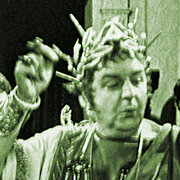
who was also handling The Rescue. Cast as
Nero was Carry On regular Derek Francis, a friend of Jacqueline
Hill's for whom a Doctor Who role had been sought since the
programme's earliest days. Spooner was surprised by the choice: Nero was
only twenty-six at the time of the Great Fire, whereas Francis would be
forty-one by the time The Romans entered production.
Work on the serial began at the BBC Television Film Studios in Ealing,
London, where model shots and the burning map of Rome were filmed on
November 17th and 18th. Episode one, The Slave Traders, was then
recorded in Riverside Studio 1 -- where all four parts would be housed
-- on December 18th. Cast and crew then enjoyed a week off for
Christmas. The second installment, All Roads Lead To Rome, was
taped on January 1st, 1965. Barry was unhappy with Nero's introductory
scene, and during the next week there was discussion of remounting it
while making Conspiracy on the 8th; however, this does not appear
to have occurred. Production wrapped with the final episode,
Inferno, on January 15th.
This was the final time Mervyn Pinfield was listed as
associate producer
Unusually, no story editor was named on-screen during The Romans;
this was done to avoid giving Spooner a dual credit. The Romans
was the final serial for which Mervyn Pinfield would be listed as
associate producer, although he had largely ceased his involvement with
Doctor Who as of The Dalek Invasion Of
Earth, at the end of the first recording block in October.
Pinfield formally stepped down on January 11th.
Meanwhile, the broadcast of The Romans part one on January 16th
established another milestone for Doctor Who, as it rose to a new
peak of seventh place amongst all programmes airing that week. With
Doctor Who now earning consistently high ratings, Verity Lambert
was informed on January 11th that the second recording block was to be
extended from twenty-six episodes to thirty-five. Furthermore, a third
production block was already being guaranteed. The final five episodes
of the second block would be held over to start Doctor Who's
third season in September.
- Doctor Who Magazine #251, 7th May 1997, “Archive: The
Romans” by Andrew Pixley, Panini UK Ltd.
- Doctor Who Magazine Special Edition #7, 12th May 2004,
“I'm Into Something Good” by Andrew Pixley, Panini
Publishing Ltd.
- Doctor Who: The Complete History #4, 2017, “Story 12:
The Romans”, edited by Mark Wright, Hachette Partworks Ltd.
- Doctor Who: The Handbook: The First Doctor by David J Howe,
Mark Stammers and Stephen James Walker (1994), Virgin Publishing.
- Doctor Who: The Sixties by David J Howe, Mark Stammers and
Stephen James Walker (1992), Virgin Publishing.
|
|
Original Transmission
|
|
| 1: The Slave Traders |
| Date |
16th Jan 1965 |
| Time |
5.40pm |
| Duration |
24'14" |
| Viewers (more) |
13.0m (7th) |
| Appreciation |
53% |
| 2: All Roads Lead To Rome |
| Date |
23rd Jan 1965 |
| Time |
5.40pm |
| Duration |
23'14" |
| Viewers (more) |
11.5m (15th) |
| Appreciation |
51% |
| 3: Conspiracy |
| Date |
30th Jan 1965 |
| Time |
5.40pm |
| Duration |
26'18" |
| Viewers (more) |
10.0m (28th) |
| Appreciation |
50% |
| 4: Inferno |
| Date |
6th Feb 1965 |
| Time |
5.40pm |
| Duration |
23'08" |
| Viewers (more) |
12.0m (13th) |
| Appreciation |
50% |
Cast
| Dr Who |
| William Hartnell (bio) |
| Ian Chesterton |
| William Russell (bio) |
| Barbara Wright |
| Jacqueline Hill (bio) |
| Vicki |
| Maureen O'Brien (bio) |
| Sevcheria |
| Derek Sydney |
| Didius |
| Nicholas Evans |
| Centurion |
| Dennis Edwards |
| Stall Holder |
| Margot Thomas |
| Slave Buyer |
| Edward Kelsey |
| Maximus Pettulian |
| Bart Allison |
| Ascaris |
| Barry Jackson |
| Delos |
| Peter Diamond |
| Tavius |
| Michael Peake |
| Woman Slave |
| Dorothy-Rose Gribble |
| Galley Master |
| Gertan Klauber |
| 1st Man in Market |
| Ernest Jennings |
| 2nd Man in Market |
| John Caesar |
| Court Messenger |
| Tony Lambden |
| Nero |
| Derek Francis |
| Tigilinus |
| Brian Proudfoot |
| Poppaea |
| Kay Patrick |
| Locusta |
| Ann Tirard |
Crew
| Written by |
| Dennis Spooner (bio) |
| Directed by |
| Christopher Barry (bio) |
|
| Title music by |
| Ron Grainer |
| with the BBC Radiophonic Workshop |
| Incidental music composed and conducted by |
| Raymond Jones |
| Fight Arranger |
| Peter Diamond |
| Costumes Supervised by |
| Daphne Dare |
| Make-up Supervised by |
| Sonia Markham |
| Lighting |
| Howard King |
| Sound |
| Richard Chubb |
| Designer |
| Raymond P Cusick |
| Associate Producer |
| Mervyn Pinfield (bio) |
| Producer |
| Verity Lambert (bio) |
|