| Previous Story: Mission To The Unknown | Next Story: The Daleks' Master Plan |
|
Serial U · Classic Series
Episodes 87 – 90: The Myth Makers
For years, the city of Troy has been besieged by Greek forces, but now both sides are growing weary of the conflict. When the TARDIS materialises, the Doctor is mistaken for the god Zeus, but he soon attracts the suspicions of the wily Odysseus. News soon comes that the Trojans have captured the TARDIS -- with Vicki still inside. Steven agrees to infiltrate Troy, while the Doctor is tasked with devising a scheme to achieve victory for the Greeks, once and for all. Inside the walls of Troy, Vicki finds romance with Troilus, youngest son of King Priam. But Troilus' sister, Cassandra, prophesies doom in the shape of a horse...
In April 1965, Donald Tosh replaced Dennis Spooner as Doctor Who's story editor. Around the same time, John Wiles was named the programme's new producer, and would gradually take over from Verity Lambert over the next few months. Both men were keen to explore more ambitious ideas than Doctor Who had attempted during its first two seasons. To this end, Tosh reached out to an old acquaintance, Donald Cotton, whose work was often imbued with a sophisticated humorous bent; Tosh hoped that he might provide a high comedy for Doctor Who. Cotton accepted Tosh's invitation, on the condition that he be allowed to choose his own subject material and involve some of his BBC Radio colleagues in the production. Wiles and Tosh were agreeable to these requests, and a storyline was commissioned around the end of April. Cotton's writing had often involved elements of Greek mythology, and so he suggested the Trojan War as a suitable setting for a Doctor Who story. Although probably based on real events now lost to history, a fictionalised narrative of the War developed through its retelling in various classical forms, most famously Homer's Iliad. Here the War was sparked by the abduction of Helen, wife of King Menelaus of Sparta, by Paris, prince of Troy. Menelaus and his brother, King Agamemnon of Mycenae, forged an alliance of Greek forces to lay siege to Troy; amongst those who fought on their side were King Odysseus of Ithaca and the hero Achilles. The Trojan War lasted for ten years, culminating in the utter destruction of Troy and the deaths of most of its citizens.
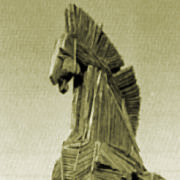
One significant element of the mythological Trojan War that likely had no basis in fact was the Trojan Horse; it may have been inspired by early siege engines, which were first being developed around that time. As such, Cotton decided to make a plot point of the Doctor's insistence that the Horse not be mentioned, for fear of changing history. Also an invention of the Iliad was Paris, who originated in earlier Greek legends. After initially planning to include him in the adventure, Cotton omitted Paris during refinements of his storyline, and then reintroduced him after the first two episodes were commissioned under the title “The Mythmakers” on May 13th. An additional inspiration during the development of “The Mythmakers” was the story of Troilus and Cressida. Variations of this romance started to appear as early as the twelfth century, and it was later made famous in the works of Boccaccio, Chaucer and Shakespeare. In the legend, the Trojan prince Troilus fell for Cressida, a young priestess. Cressida ultimately left Troilus for the Greek warrior Diomede, leading to Troilus' death during the siege of Troy. Cotton envisioned Vicki taking on the name Cressida and becoming romantically involved with Troilus, only to leave at the story's conclusion with Diomede -- the guise assumed by Steven. Cotton also made liberal use of other Greek myths in his dialogue and in naming his characters. The spy Cyclops, for example, took his name from the legendary one-eyed giants who would most famously appear in the Odyssey, Homer's sequel to the Iliad. At one point, Cotton also envisaged roles for Priam's wife, Hecuba, and Hector's wife, Andromache, although neither would appear in the finished scripts. The action of the concluding installments evolved considerably as Cotton developed “The Mythmakers”. At an early stage, he intended to wrap up the Trojan elements of the narrative by the end of Episode Two, with the latter half of the serial concentrating on the Greeks' journey home. Once it was decided to focus solely upon the Siege of Troy, Episode Four saw Steven and Vicki freed by Priam after the horse was brought into the city. They used Morse code to make contact with the Doctor. When the Greeks burst out of the horse, the Doctor and Steven reclaimed the TARDIS, but Vicki returned to the palace to recover a memento given to her by Helen. There she witnessed Priam nearly defeat Achilles in battle, only to be slain by Odysseus. The element of Steven being wounded was added at the request of Terry Nation, who planned to make use of the development in the first episode of the next serial, The Daleks' Master Plan. By the time the third and fourth episodes were commissioned on June 11th, the story's title had been amended to “The Myth-Makers”. This was subsequently altered again, to The Myth Makers. (The name “The Trojans” also appeared on some documentation, and “The Trojan War” has been suggested as another working title.) The BBC objected to the punning theme that Cotton devised for his episode titles; only the original name for the second episode -- Small Prophet, Quick Return -- survived, at Tosh's insistence.
The Myth Makers was scheduled to be the first serial made as part of Doctor Who's third production block, although Galaxy 4 and Mission To The Unknown were held back from the second block to start the broadcast season. During the making of Galaxy 4 in July, John Wiles had been unhappy to hear Maureen O'Brien complain about her dialogue. He decided that Vicki would be written out in The Myth Makers, which coincided with the expiry of O'Brien's contract. Cotton's storyline was therefore amended to have Vicki stay with Troilus and help him escape the siege of Troy, despite the fact that this now contradicted the traditional myth. To replace Vicki, Wiles and Tosh conceived a new companion who would be introduced in the final episode of The Myth Makers: the Trojan handmaiden, Katarina. However, it quickly became clear that the character would be virtually unworkable on ongoing basis; since she came from such a remote period of Earth's history, she would constantly need to have even the simplest things explained to her in subsequent stories. As a result, Wiles and Tosh elected to kill off Katarina midway through The Daleks' Master Plan. The original candidate considered to direct The Myth Makers was Derek Martinus, who wound up being urgently pressed into service on Galaxy 4 and Mission To The Unknown. Instead, Michael Leeston-Smith was brought aboard, with his first order of business being the material on the plains around Troy, filmed at Frensham Little Pond in Frensham, Surrey. This was Doctor Who's most extensive location shoot in more than a year: work began on August 27th, and then continued from August 30th to September 2nd. Both Cavan Kendall (playing Achilles) and James Lynn (Troilus) received minor injuries during their fight scenes, forcing several remounts. Shortly after location shooting wrapped up, Leeston-Smith spent a day (possibly September 3rd) filming model shots at the Ham Polo Club in Ham, Middlesex. Meanwhile, the regular cast had returned from their month off, unaware that a cast change was afoot. Maureen O'Brien had been issued a revised contract on July 30th, which included a BBC option for twenty episodes beyond The Myth Makers; she had scarcely contemplated the possibility that this might not be taken up. The actress was therefore shocked when, on September 3rd, she was informed that The Myth Makers would be her Doctor Who swansong. Despite her surprise, O'Brien was not entirely unhappy with the situation, as she had become dissatisfied with the role of Vicki. On the same day, Peter Purves' contract was extended through The Ark. On September 9th, Adrienne Hill was cast as Katarina. This decision was made by Douglas Camfield, the director of The Daleks' Master Plan. Ironically, Hill's first work on Doctor Who would be filming her death scene for that story. O'Brien's abrupt dismissal drove another wedge into the relationship between William Hartnell and John Wiles. Hartnell was already uncomfortable with Wiles' approach to Doctor Who, and missed Verity Lambert's presence; The Myth Makers would be the first serial on which Wiles would be credited as producer. To make matters worse, Hartnell's health was in decline, with arteriosclerosis increasingly impeding his ability to remember his lines. The series star was also unhappy with what he felt was a diminished role for the Doctor in Cotton's scripts. Hartnell feared that he was being upstaged by prominent guest stars, including Francis de Wolff (Agamemnon) and especially Max Adrian (Priam). Adrian was Jewish and a homosexual, neither of which Hartnell condoned.
The Myth Makers saw Doctor Who return to its regular home of Riverside Studio 1 in Hammersmith, London; each episode was taped on consecutive Fridays, beginning on September 17th. During camera rehearsals for the first episode, Temple Of Secrets, Hartnell was bruised after being struck on the shoulder by a camera platform, although he soldiered on through the taping. The following week, the series star was bereaved by the death of his Aunt Bessie, the only family member with whom he had been close during his troubled youth. Sadly, his responsibilities to The Myth Makers would preclude him from attending her funeral. Hartnell suffered another injury during the work at Riverside, as the result of an altercation at a nearby pub during the lunch hour; a black eye had to be hastily concealed beneath make-up. Meanwhile, Adrienne Hill appeared in the studio for the first time on October 8th, when Horse Of Destruction was recorded. This was also Maureen O'Brien's final day on Doctor Who. To this point, Doctor Who episodes had rarely undergone substantial post-production editing, but Horse Of Destruction was an exception. There were several cuts, one of the more significant of which was a major scene involving Hill. This was an exchange between Vicki and Katarina, in which the Trojan girl discussed how she came to serve as a handmaiden. In the process, Katarina revealed that recent auguries had foretold her imminent demise...
|
|
|||||||||||||||||||||||||||||||||||||||||||||||||||||||||||||||||||||||||||||||||||||||||||||||||||||||||||||||||||||||||||||||||||||||||||||||||||||
| Updated 25th July 2023 |
| Return To | ||
|---|---|---|
| Main Page | Episode List | Season 3 |
| Previous Story: Mission To The Unknown | Next Story: The Daleks' Master Plan |