| Previous Story: The Beast Below | Next Story: The Time Of Angels / Flesh And Stone |
| Next in Production: The Eleventh Hour |
|
Modern Series Episode 65: Victory Of The Daleks
Prime Minister Winston Churchill summons the Doctor and Amy to Blitz-torn London. The British forces are at their lowest ebb, but a scientist named Bracewell has come to Churchill with a series of amazing ideas and inventions: hypersonic flight, gravity bubbles... and powerful miniature tanks he calls “Ironsides”. The Doctor, however, recognises the Ironsides for what they really are: Daleks. With a Nazi bombing run closing in, and Churchill convinced of the Ironsides' benevolence, the Doctor unearths a terrible scheme to initiate a new era of Dalek supremacy.
During the four seasons of Doctor Who overseen by Russell T Davies, a popular innovation was the “celebrity historical”: a story set in Earth's past in which the Doctor and his companion met a famous individual. The annual tradition started with Mark Gatiss' The Unquiet Dead in 2005, which was set in Victorian London and featured Charles Dickens. Most recently, 2008's The Unicorn And The Wasp plunged the Doctor and Agatha Christie into a 1926 murder mystery. New executive producer Steven Moffat wanted to continue this tradition for Season Thirty-One. A potential setting presented itself after he and his sons, Joshua and Louis, visited the Cabinet War Rooms beneath Whitehall. Now a museum, during the Second World War they had been the base of operations for Winston Churchill, one of the key Allied figures in the battle against the Axis powers. Churchill had become Prime Minister following the resignation of Neville Chamberlain in 1940, and he remained in office until being ousted by the electorate soon after the end of the war in Europe in 1945. A second term as Prime Minister followed from 1951 to 1955. At the same time, Moffat was keen to bring the Daleks back to Doctor Who. He felt that audiences expected the Doctor's oldest enemies to put in an appearance on a more-or-less yearly basis, and since no full season had aired in 2009, there would be a pent-up demand for the Daleks in 2010. Indeed, Davies would later agree to omit the Daleks from The End Of Time -- David Tennant's swansong as the Tenth Doctor -- in order to provide a boost to their reemergence during Season Thirty-One. It occurred to Moffat that one way to put an original spin on both the celebrity historical and the Daleks was to combine them. The Doctor and Churchill would be old friends, and together they would confront a Dalek threat. Introducing the Daleks into a Second World War setting seemed like a natural fit, since the Nazis had been a significant influence on Terry Nation when he created the monsters in 1963.
To write the script, Moffat turned to Gatiss. Although he had not written a televised Doctor Who story since Season Twenty-Eight's The Idiot's Lantern, he had subsequently developed the ultimately-unused “The Suicide Exhibition”, the latter iterations of which were likewise set during the Second World War. Gatiss had also appeared as the eponymous villain of Season Twenty-Nine's The Lazarus Experiment. Since then, he and Moffat had been setting up Sherlock, which transplanted Arthur Conan Doyle's Sherlock Holmes mysteries to the present day. This experience had given Moffat enormous confidence in Gatiss, whom he knew to be very comfortable writing for an historical setting. Gatiss was offered the Dalek story around September 2008, and he began writing his script during the latter part of the year. For the tone of his narrative, Gatiss looked to classic British war movies such as 1955's The Dam Busters and 1968's Where Eagles Dare. Indeed, the script acknowledged the latter's influence by borrowing its call signs. Gatiss also wanted to spotlight the Supermarine Spitfire, the aircraft which became the favourite of the Royal Air Force during the Second World War and was often considered to be one of the most effective British weapons against the Nazis. For his portrayal of the Daleks, Gatiss was keen to emphasise their deviousness and skill at manipulation. These were characteristics which had been especially prominent in his favourite Dalek story, 1966's The Power Of The Daleks. Gatiss decided to reprise its basic concept of the Daleks masquerading as factotums for a group of humans -- now the British government at wartime, rather than colonists on an alien planet. The Daleks would utter the line “I am your soldier” in homage to the earlier story's eerie “I am your servant”. Perhaps the most significant decision made by Moffat and Gatiss was to use this story as a vehicle to redesign the Daleks. When Doctor Who was revived in 2005, the appearance of the Daleks had remained very faithful to what had been seen on television during the twentieth century. With so many of the show's visual elements changing to herald the start of Matt Smith's tenure as the Eleventh Doctor, Moffat felt that this presented an excellent opportunity to update the Daleks as well. He wanted them to be bigger and more menacing, but also more colourful. In particular, he and Gatiss both thought in terms of the Doctor Who feature films released by Aaru Pictures in 1965 and 1966, which had boasted towering Daleks in a variety of Technicolor liveries.
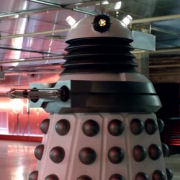
The task of redesigning the Daleks fell to production designer Edward Thomas, who worked in tandem with concept artist Peter McKinstry. One of their goals was to create a more aggressive appearance for the Daleks which eschewed obvious man-made components such as bolts and rivets. The pair conceived some very radical departures from the traditional Dalek image, but Moffat encouraged them to retain the same basic silhouette. Ultimately, the most significant changes included an angled, sharp-edged head grille and a bulkier rear skirt section, which Thomas conceived as storing various weapons that could be interchanged with the Dalek's other armaments. McKinstry also intended the skirt section to sport raised blades between each panel, but this feature proved impossible to fabricate in the time available. At Moffat's suggestion, the eyepiece was given an organic component to remind viewers of the living creature housed in the Dalek shell. The Daleks introduced in 2005 had been sized so that the dome would be level with the eyeline of Billie Piper, who had played companion Rose Tyler. The new Daleks, on the other hand, were proportioned relative to the taller Karen Gillan, as well as Smith himself. A variety of different colour schemes was considered for the new Daleks. McKinstry felt that a metallic sheen remained preferable, but Moffat was inclined towards bright colours. It was ultimately decided that five new casings would be constructed, each in a different livery to signify a distinct function. Gatiss coined the names of the white Supreme (reusing a Dalek rank first identified in 1964's The Dalek Invasion of Earth), the red Drone, the orange Scientist and the blue Strategist; Moffat contributed the yellow Eternal, although he had no specific plans for what this enigmatic title might signify. Black, green and purple Daleks were also considered but rejected. Meanwhile, three of the existing Dalek casings were repainted to serve as the Ironsides Daleks. The fourth -- the original version built for 2005's Dalek -- was now permanently housed at BBC Birmingham. Since Gatiss' story would culminate with the introduction of this new “Dalek Paradigm”, it was given the title Victory Of The Daleks. Amongst the supporting characters, Gatiss gave Lilian the surname Breen, which was the maiden name of the mother of his husband, Ian Hallard. Lilian was part of Gatiss' effort to remind viewers of the very real people who fought and suffered during the Second World War, an event which was now often portrayed as more of a thrilling escapade than a global tragedy with a massive human cost. Likewise, Bracewell's sheepish memories of Dorabella became the key to defusing the bomb because Gatiss felt that this kind of mild embarrassment was a virtually universal emotion.
Together with the preceding adventure, The Beast Below, Victory Of The Daleks would be directed by Andrew Gunn as part of the year's second production block. Cast in the pivotal role of Churchill was Ian McNeice, who had previously appeared in the 2007 Doctor Who audio drama Immortal Beloved from Big Finish Productions. In fact, this would be McNeice's second opportunity to portray Churchill; during 2008, he had taken the same role in Never So Good, a play about Harold Macmillan, who was one of Churchill's successors as Prime Minister. For the War Rooms where much of the action of Victory Of The Daleks took place, it was originally anticipated that a studio set would have to be constructed. However, the production team was able to secure permission to use the bunker of the Joint Resilience Unit in Swansea, which had been an actual Ministry of Defence command centre during the Fifties. Work there began on August 21st, 2009 and then continued after the weekend from the 24th to the 26th. The main focus on all four days was the map room, although scenes in Churchill's office were also recorded on the 24th and the 26th. On August 27th, Cardiff University's Glamorgan Building provided the rooftop from which Bracewell demonstrated the Ironsides. Material in the laboratory was filmed on August 28th and 29th in the basement of Jacob's Antique Centre in Cardiff; the sequence in the lift was also taped there on the second day. This work included part of a revised ending which Moffat had now conceived for Victory Of The Daleks. A coda originally depicted a blithe Bracewell visiting the post office from his memories. The Doctor and Amy watched from beside a nearby cottage, and it was on the wall of this building that the crack in time appeared. However, Moffat had come to feel that it would be more effective to depict the Doctor giving Bracewell a new lease of life in a dialogue-driven piece. Gunn and his team had Sunday the 30th off. August 31st and September 1st were then spent at Brackla Bunkers in Bridgend, for scenes in the storage area and various corridors. The dialogue which the Doctor and Amy were originally meant to exchange outside the post office was rewritten to take place outside the TARDIS. The final location used for Victory Of The Daleks was the humidifier area of Freeman's Cigar Factory in Penarth, which was then in the process of being decommissioned. The huge steel-walled space served as the interior of the Dalek saucer from September 2nd to 4th, although cast and crew had to contend with the intense heat which was generated by the reflection of the lights erected for the production. The five new Dalek casings made their debut during the recording at Penarth; however, the plan for the Dalek Supreme to introduce each of his cohorts by name was abandoned when it was felt to be too reminiscent of a beauty pageant. Gunn then turned his attention to The Beast Below, although two more days of work at Doctor Who's usual studio facilities in Upper Boat were still required for Victory Of The Daleks. TARDIS scenes were taped there on September 8th, followed by the Spitfire material on the 23rd. In post-production, the voice of the Spitfire pilot was provided by Gatiss himself. Dropped at this stage was a sequence aboard the Dalek ship, in which the Doctor was shown images from their previous encounters. Some adventures -- such as The Power Of The Daleks -- were to be represented by newly-created footage, featuring a variety of Dalek casings borrowed from longtime fan Andrew Beech. Also cut was a TARDIS sequence in which Amy listened as the Doctor described his history with Churchill. He was to mention a fist fight in the Sudan (where Churchill was a junior officer and a journalist in 1898), dodging doodlebugs (early cruise miles used by the Nazi Luftwaffe) in 1945, and attending Churchill's memorial service at St Paul's Cathedral on January 30th, 1965. Victory Of The Daleks was broadcast on April 17th, 2010. For the third week in a row, Doctor Who occupied a slightly different time slot. Afternoon coverage of a rugby match between Hull and Leeds pushed the Dalek adventure slightly later than its two predecessors, to 6.30pm. However, viewers who wanted to watch the Doctor battle the Daleks in high definition had to wait until 8.25pm that evening. This was because BBC HD carried a selection of content from across all of the standard-definition BBC channels and, on this occasion, the decision was made to prioritise a simulcast of BBC Two's Match Of The Day Live, featuring West Bromwich Albion versus Middlesbrough.
|
|
| Updated 1st August 2022 |
| Return To | ||
|---|---|---|
| Main Page | Episode List | Season 31 |
| Previous Story: The Beast Below | Next Story: The Time Of Angels / Flesh And Stone |
| Next in Production: The Eleventh Hour |