Serial 5Q · Classic
Series Episodes 530 – 533:
Meglos
The Doctor's old friend Zastor summons him back to the planet Tigella,
where the population is divided between the zealous Deons and the
scientific Savants. Something is going wrong with the Dodecahedron,
Tigella's main power source, but the Deons have forbidden the Savants
from investigating. Meanwhile, on the nearby world of Zolfa-Thura, a
group of mercenaries revives the ruined planet's last survivor: the
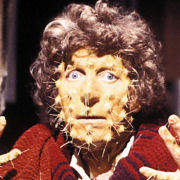
cactus-like Meglos. The shapeshifting Meglos steals the Doctor's form
and traps the TARDIS in a time loop. He then travels to Tigella, where
his goal is to steal the Dodecahedron -- and frame the Doctor for the
crime.
When Christopher H Bidmead became Doctor Who's script editor at
the start of 1980, he found himself scrambling to develop stories for
the programme's upcoming eighteenth season. Both he and producer John
Nathan-Turner were eager to bring new talent onto the show, and so one
of the first people Bidmead contacted was an actor he knew named Andrew
McCulloch. McCulloch had formed a writing partnership with a fellow
thespian, John Flanagan, although their only televised work to date was
an unsuccessful sitcom pilot called Bricks Without Straw. In
early February, Flanagan and McCulloch developed a story idea focussing
on an exaggerated schism between science and religion, which was
exploited by the villainous Meglos -- whose true nature was inspired
by a potted cactus sitting on McCulloch's kitchen table.
On February 25th, Flanagan and McCulloch were commissioned to expand
Meglos into a scene breakdown. Nathan-Turner was unimpressed
with an adventure that he saw as just standard Doctor Who fare,
and Bidmead felt that the writers were expending too little effort on
the plot and too much on the eponymous villain. Nonetheless, with little
time to seek an alternative, full scripts were requested on March 10th.
Since Flanagan and McCulloch wrote quickly, it was decided that
“The Golden Star” -- as the adventure had now been renamed
-- would be the third story into production, coming after The Leisure Hive and State Of Decay. Unlike the latter, “The
Golden Star” would not feature new companion Adric, and so it
would be the year's second broadcast adventure, coming immediately
before his introduction in Full Circle.
The name Brotadac was jokingly devised as an anagram of
“bad actor”
During the writing process, a number of working titles were considered
-- apparently including “The Golden Pentangle”, “The
Golden Pentagram” and “The Last Sol-Fataran” -- before
the serial became “The Last Zolfa-Thuran” by the end of
April. Several of these names reflected the evolving shape of the
Dodecahedron: it was originally a five-sided object, thereby influencing
the number of screens found on Zolfa-Thura, rather than a twelve-sided
object made up of pentagons. Keen to inject more science into Flanagan
and McCulloch's scripts, Bidmead suggested the inclusion of the chronic
hysteresis, deriving the terminology from a loop-like phenomenon
encountered in disciplines such as electromagnetism. Meanwhile, Flanagan
and McCulloch jokingly devised the name Brotadac as an anagram of
“bad actor”!
As with Peter Moffatt on State Of Decay,
Nathan-Turner chose a former colleague from All Creatures Great And
Small to direct “The Last Zolfa-Thuran”. This was
Terence Dudley, whose friend Alvin Rakoff was married to Jacqueline
Hill, one of the original stars of Doctor Who. Hill had played
Barbara Wright between 1963 and 1965, and had subsequently paused her
acting career to raise the couple's children. She was now eager to
return to work, and Dudley offered to cast her as Lexa in “The
Last Zolfa-Thuran” -- much to the approval of Nathan-Turner, who
was keen to appeal to the show's longtime fans. In Flanagan and
McCulloch's original storyline, Lexa had simply faded from the narrative
once she ceased contributing to the plot. Bidmead suggested her act of
self-sacrifice as a more dramatic end for the character.
One of Nathan-Turner's earliest decisions as producer had been to drop
both Romana and K·9 from Doctor Who partway through Season
Eighteen. Although Lalla Ward had already revealed her imminent
departure to the British press in May, it took until June 7th for word
of K·9's upcoming exit to leak out. It was The Sun that
initially revealed the news and, despite being provided some
vaguely-worded denials by Nathan-Turner, the paper seized on the
opportunity to drum up publicity and outrage by launching a “Save
K·9” letter-writing campaign.
Although Flanagan and McCulloch had hoped that many of the scenes on
Zolfa-Thura and in the Tigellan jungle would be achieved on location,
Nathan-Turner decided that their scripts represented an opportunity to
save money by confining all recording to the studio. For a time, it was
suggested that the Gaztaks might exhibit an East Asian appearance, with
Bill Fraser and Frederick Treves (as Grugger and Brotadac) made up
accordingly, but this notion was dropped. Ward's costume for “The
Last Zolfa-Thuran” was inspired by Frances Hodgson Burnett's 1886
children's novel Little Lord Fauntleroy. Meanwhile, Bidmead was
required to significantly expand some of the scripts -- particularly
Episode Three, which was found to be running seven minutes short.
Amongst the added material was Romana leading the Gaztaks in a circle
through the jungle.
Meglos suited John
Nathan-Turner's preference for more varied and unusual story titles
The serial's first studio session was held from June 25th to 27th at BBC
Television Centre Studio 8 in White City, London. Rather than taking the
usual approach of recording set-by-set, Dudley opted to mix and match
material from all of the Tigellan locales on each of the three days. Tom
Baker was now slowly recovering from the illness which had plagued him
for weeks, but his long convalescence was still dampening his mood, and
he disliked the latex facial appliance he had to wear to give him a
cactus-like appearance. By this stage, the adventure was once again
known by the writers' original choice: Meglos. This suited
Nathan-Turner's preference for more varied and unusual story titles in
Doctor Who.
The second studio block took place in TC3 and spanned July 10th to 12th,
with Dudley now primarily concentrating on the Zolfa-Thuran sequences.
The TARDIS scenes were also recorded on the first day, modelwork was
completed on the second day, and the last day included material aboard
the Gaztak spaceship. A major element of the work scheduled for July
11th was the use of a new process called Scene-Sync, which was a more
advanced version of the chroma key technique used on Doctor Who
since 1969. Chroma key relied on two cameras, with the output of one
camera electronically replacing a “key” colour in the output
of the other. Unfortunately, the effect was often spoilt if the cameras
had to move, since it was almost impossible to do so synchronously.
Scene-Sync remedied this issue by electronically slaving one camera to
the other. It was an unproven process at the BBC, and so it was offered
to Doctor Who for use on Meglos as a test case, free of
charge. Dudley's implementation of Scene-Sync for some of the
Zolfa-Thuran sequences was judged to be a success and, as a result, the
technology became more widely adopted.
The broadcast of Meglos coincided with the BBC's announcement on
October 7th that K·9 would indeed be leaving Doctor Who
after all. Like The Leisure Hive, the
serial's first two episodes were scheduled at 6.15pm, bookended by
The Dukes Of Hazzard (plus the news) and Larry Grayson's
Generation Game. With strong opposition from Buck Rogers In The
25th Century on ITV, ratings continued to flounder. As such, with
Episode Three on October 11th, the BBC shook up its Saturday evening
schedule. Doctor Who was brought forward to 5.40pm, and The
Basil Brush Show returned as its lead-in. Larry Grayson still
followed the Doctor, but now with a news update in-between. Despite
Bidmead's efforts, all four episodes of Meglos were very short,
with Episode Four running for less than twenty minutes. As a result, it
was scheduled in a shorter timeslot, starting at 5.45pm.
Meanwhile, on August 29th, popular waxworks museum Madame Tussauds had
unveiled a display called The Doctor Who Experience to celebrate
the debut of the programme's eighteenth season the next day. The exhibit
included a waxwork of Tom Baker, in costume as the Fourth Doctor.
Following the broadcast of Meglos, the display gained a statue of
the Doctor's Meglos doppelganger. Consequently, Baker became the first
person to be represented at Madame Tussauds by two different waxworks at
the same time.
- Doctor Who Magazine #285, 15th December 1999, “Archive:
Meglos” by Andrew Pixley, Marvel Comics UK Ltd.
- Doctor Who Magazine Special Edition #9, 22nd December 2004,
“Another One Bites The Dust” by Andrew Pixley, Panini
Publishing Ltd.
- Doctor Who: The Complete History #32, 2017, “Story 110:
Meglos”, edited by Mark Wright, Hachette Partworks Ltd.
- Doctor Who: The Eighties by David J Howe, Mark Stammers and
Stephen James Walker (1996), Virgin Publishing.
- Doctor Who: The Handbook: The Fourth Doctor by David J Howe,
Mark Stammers and Stephen James Walker (1992), Virgin Publishing.
- In·Vision #47, November 1993, “Production”
edited by Justin Richards and Peter Anghelides, Cybermark Services.
|
|
Original Transmission
|
|
| Episode 1 |
| Date |
27th Sep 1980 |
| Time |
6.16pm |
| Duration |
24'43" |
| Viewers (more) |
5.0m (105th) |
| Appreciation |
61% |
| Episode 2 |
| Date |
4th Oct 1980 |
| Time |
6.17pm |
| Duration |
21'24" |
| Viewers (more) |
4.2m (139th) |
| Appreciation |
64% |
| Episode 3 |
| Date |
11th Oct 1980 |
| Time |
5.42pm |
| Duration |
21'19" |
| Viewers (more) |
4.7m (129th) |
| Episode 4 |
| Date |
18th Oct 1980 |
| Time |
5.44pm |
| Duration |
19'30" |
| Viewers (more) |
4.7m (127th) |
| Appreciation |
63% |
Cast
| Doctor Who |
| Tom Baker (bio) |
| Romana |
| Lalla Ward (bio) |
| Voice of K·9 |
| John Leeson (bio) |
| General Grugger |
| Bill Fraser |
| Lieutenant Brotadac |
| Frederick Treves |
| Zastor |
| Edward Underdown |
| Lexa |
| Jacqueline Hill (bio) |
| Caris |
| Colette Gleeson |
| Deedrix |
| Crawford Logan |
| Earthling |
| Christopher Owen |
| Tigellan Guard |
| Simon Shaw |
Crew
| Written by |
| John Flanagan (bio) and |
| Andrew McCulloch (bio) |
| Directed by |
| Terence Dudley (bio) |
|
| Incidental Music |
| Paddy Kingsland |
| Peter Howell |
| Special Sound |
| Dick Mills |
| Production Assistant |
| Marilyn Gold |
| Production Unit Manager |
| Angela Smith |
| Director's Assistant |
| Hermione Stewart |
| Assistant Floor Manager |
| Valerie McCrimmon |
| Visual Effects Designer |
| Steven Drewett |
| Video Effects |
| David Jervis |
| Vision Mixer |
| Graham Giles |
| Technical Manager |
| Brendan Carr |
| Senior Cameraman |
| Alec Wheal |
| Video Tape Editor |
| Ian Williams |
| Sam Upton |
| Lighting |
| Bert Postlethwaite |
| Sound |
| John Holmes |
| Costume Designer |
| June Hudson |
| Make Up Artist |
| Cecile Hay-Arthur |
| Script Editor |
| Christopher H Bidmead (bio) |
| Title Sequence |
| Sid Sutton |
| Designer |
| Philip Lindley |
| Executive Producer |
| Barry Letts (bio) |
| Producer |
| John Nathan-Turner (bio) |
Working Titles
| The Golden Star |
| The Golden Pentangle |
| The Golden Pentagram |
| The Last Sol-Fataran |
| The Last Zolfa-Thuran |
|