| Previous Story: Meglos | Next Story: State Of Decay |
| Next in Production: Warriors' Gate |
|
Serial 5R · Classic
Series Episodes 534 – 537: Full Circle
Romana is recalled to Gallifrey, only for the TARDIS to be drawn into another universe called E-Space. The time travellers land on the planet Alzarius, where a Starliner from Terradon crashlanded long ago. Generations later, the ship is still being repaired, but now the dreaded time of Mistfall has arrived, during which savage Marshmen rise from the swamps. While the ruling Deciders seal most of their people aboard the Starliner, Romana meets the renegade Outlers, who refused to heed the summons. The Doctor sneaks aboard the ship, where he discovers that the Deciders are harbouring terrible secrets.
When new Doctor Who script editor Christopher H Bidmead began reviewing the programme's files in early 1980, his attention was drawn to a storyline entitled “The Planet That Slept”. It was written by Andrew Smith, who had been encouraged to submit material for the series by several of Bidmead's predecessors. Bidmead was urgently seeking ideas for Doctor Who's eighteenth season, and he and producer John Nathan-Turner both wanted to recruit new writers to the show. As such, he invited Smith to a meeting in February to discuss guiding “The Planet That Slept” into a more suitable form. What Bidmead did not anticipate was that Smith was, in fact, a seventeen-year-old Doctor Who fan. In Smith's original outline, the adventure involved the TARDIS arriving on the planet Alzarius, where Neanderthal-like Marshmen rose from the swamps during the time of Mistfall. As the Doctor and Romana explored, a space freighter crashlanded on Alzarius, and the time travellers tried to help its crew repair the ship while fending off the Marshmen and gigantic cave-dwelling spiders. They were aided by a young Marshchild, who was rejected by the rest of her kind due to her pacifist nature. In the end, the Marshchild sacrificed herself to keep the Doctor and Romana safe until the mists vanished and the Marshmen retreated to the swamps.
Bidmead was impressed with the striking images that Smith conjured in “The Planet That Slept”, and decided to help him refine the storyline despite the writer's youth and inexperience. Bidmead wanted to give Doctor Who a much stronger scientific underpinning, and so he and Smith decided to make evolution an underlying theme of the narrative. The Marshmen, the spiders -- no longer giant, since the production team was wary that they would be too difficult to realise convincingly -- and even the ship's crew would all represent different evolutionary stages of the same race. The space freighter became a passenger liner which had crashlanded on Alzarius centuries earlier. Smith also had to integrate elements of a story arc conceived by Bidmead, of which “The Planet That Slept” would be the first in a trilogy. It had been developed at the suggestion of fan adviser Ian Levine, who recalled the tighter continuity between stories which had sometimes been seen in Doctor Who during the Sixties. For his part, Bidmead wanted to impart more meaning to the Doctor's seemingly aimless wandering. Nathan-Turner was less keen on this idea, having witnessed the difficulties that an overarching plot had imposed on Season Sixteen, when every story involved the search for a segment of the Key To Time. However, he ultimately consented to Bidmead's notion of a shorter story arc, in which the TARDIS became trapped in an anti-matter universe. Most significantly, Smith was asked to introduce a new companion called Adric, devised by Nathan-Turner in order to make the regular cast of characters less invincible. The character had already been written into State Of Decay, which would be made before Adric's debut serial but broadcast afterwards. It was decided that Adric would take over some of the Marshchild's role in “The Planet That Slept”. Smith also had to incorporate Adric's brother, whom Nathan-Turner had called Afrus, but would now be rechristened Varsh. On February 25th, Bidmead commissioned Smith to write the first episode of “The Planet That Slept”. Satisfied with the result, he requested the final three installments on March 31st. It was now known that Smith's adventure would be the fourth story into production, but the third to be screened. During the scripts' development, a power struggle amongst the Outlers between Varsh and Tylos was eliminated, while a Marshchild character was reintroduced, replacing a mature Marshwoman. Lexeter was renamed Dexeter -- to avoid confusion with Lexa in Meglos, the preceding serial in the transmission order -- while Terradon was initially spelt “Teradon”.
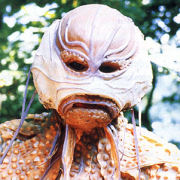
The notion of Alzarius' coordinates being the negative of Gallifrey's, and the Gallifreyan wilds appearing on the TARDIS scanner, came from Nathan-Turner. Indeed, for a time, the planet was referred to as Yerfillag: “Gallifrey” backwards. To help him understand Adric, Smith developed a detailed backstory which did not make it into the narrative. To explain Adric's distrust of the Deciders, Smith posited that he had discovered that his parents' seemingly accidental death aboard the Starliner had actually been contrived by Draith, in order to encourage a more conservative attitude amongst the Terradonians towards the possibility of embarkation. Bidmead's story arc was detailed in a document issued on June 12th. It explained that the TARDIS would pass through a Charged Vacuum Emboitment, a region of space-time in which the interaction between matter and anti-matter particles and strong electromagnetic fields had created the doorway to a number of tiny subsidiary universes. Instead of an anti-matter universe as originally proposed, the Doctor and Romana would now become trapped in one of these “exo-space/time continuums” -- dubbed “E-Space”, while the normal universe was “N-Space”. Because E-Space would be very small -- containing just two galaxies -- the Doctor would have an unprecedented ability to steer the TARDIS. In addition to providing the background for the three E-Space stories, Bidmead planned that these details would also presage elements of the season finale. On June 19th, Bidmead rechristened Smith's serial Full Circle to address Nathan-Turner's unhappiness with the original title. The assigned director was Peter Grimwade, who had previously worked on Doctor Who as a production assistant dating back to Spearhead From Space in 1969; like several of the season's other directors, he had come to know Nathan-Turner on All Creatures Great And Small. Grimwade was also a writer, and had been working on a Doctor Who storyline for several months which would ultimately become the following season's Time-Flight. As Keara and Varsh, Grimwade cast June Page and Richard Willis; romance blossomed between the pair, and they were subsequently married for a time. Both costume designer Amy Roberts and visual effects designer John Brace pitched ways of depicting the Marshmen. Grimwade opted for Roberts' approach, which was much more monstrous than Smith had envisaged. Work on Full Circle began with three days on location at Black Park in Fulmer, Buckinghamshire, from July 23rd to 25th. Waterhouse rejoined the cast, having not appeared in Meglos, which was made after State Of Decay. He struggled with the portrayal of Adric in Full Circle, since he felt that it was not entirely consistent with the way the character had previously been presented. Smith visited the shoot on the first day, but was suffering from a virus and vomited on the Marshmen costumes. The initial studio session for Full Circle took place on August 7th and 8th at BBC Television Centre Studio 3 in White City, London. The opening day dealt with all of the interior TARDIS sequences, while the second day was concerned with material in the lower decks and entrance hatches of the Starliner, as well as in the cave. It was only during rehearsals for this block that the Alzarians' ability to rapidly heal injuries was introduced; previously, Adric's knee had been mended by a spray that the Doctor provided. The rest of Full Circle was recorded between August 21st and 23rd, with the venue switching to TC6. The first day focussed on the set for the Science Unit; Grimwade also opted to remount some of the cave scenes. On the second day, model sequences were shot alongside material in the Great Book Room. The baby Terradonian was played by Alys Dyer, the daughter of production unit manager Angela Smith, who had also appeared in The Leisure Hive earlier in the year. Scenes in the boarding area and corridors of the Starliner were completed on the final day of the block. New dialogue recorded during post-production on Full Circle added the tannoy announcement mentioning Citizen Darchir. An anagram of “Richard”, it referred to Smith's friend Richard Walter, the editor of the Doctor Who Appreciation Society fanzine TARDIS. Despite submitting several further ideas to the Doctor Who production office, Full Circle was Smith's final televised contribution to the programme. Meanwhile, around the time that Full Circle was in production, it became clear that Tom Baker would not be returning to Doctor Who for an eighth season. Baker was already the longest-serving Doctor by two years, and was becoming visibly tired of the job. He had also grown to dislike several of the changes that Nathan-Turner had made to the series, and did not get along well with Waterhouse. Baker had hinted about leaving Doctor Who several times in recent years, but it was now clear that both the actor and the production team saw eye to eye on the situation. The final straw came when Nathan-Turner suggested that Baker would not be in line for a pay raise for Season Nineteen. Baker's forthcoming departure would be announced on October 24th, the day before the debut episode of Full Circle was broadcast. Meanwhile, with the first change of lead actor since 1974 looming, Nathan-Turner and Bidmead found themselves planning for a genuine end of an era...
|
|
|||||||||||||||||||||||||||||||||||||||||||||||||||||||||||||||||||||||||||||||||||||||||||||||||||||||||||||||||||||||||||||||||||||||||||||||||||
| Updated 21st May 2021 |
| Return To | ||
|---|---|---|
| Main Page | Episode List | Season 18 |
| Previous Story: Meglos | Next Story: State Of Decay |
| Next in Production: Warriors' Gate |