Serial 6D · Classic
Series Episodes 584 – 587:
Snakedance
Five centuries ago, Manussa was the seat of the Mara's empire. There it
was seemingly destroyed by the Great Crystal, but was really only
banished into dreams. Now many Manussans consider the Mara to be little
more than a fairytale, while it has been patiently awaiting the
opportunity to restore its power. Seizing control of Tegan's mind, the
Mara compels her to direct the TARDIS to Manussa. There she corrupts
Lon, the Federator's son, who will be the vessel for the Mara's return.
With few besides the Snakedancers in the hills standing guard against
the Mara, only the Doctor can prevent its return and save his
companion.
By the time Kinda, Christopher Bailey's
first Doctor Who serial, was wrapping up production in August
1981, he and script editor Eric Saward were already discussing a
possible sequel. Saward thought that the Mara, the villain of the piece,
was ripe for further exploration, and that this would be an opportunity
to develop Tegan Jovanka. Bailey was wary of returning to Doctor
Who, having been unhappy with the extent of the rewrites Saward had
performed on his scripts for Kinda, but he
relented when he was promised that any such interference would be
minimal. Working closely with Saward, Bailey drafted an outline for a
new story called Snakedance -- sometimes referred to as
“Snake Dance” -- which was commissioned on September 28th.
Happy with the outcome, Saward requested the full scripts from Bailey on
November 9th.
As with Kinda, Bailey infused the names he
chose for Snakedance with hidden meanings. Buddhist terms again
made an appearance, inspiring Manussa (“the human realm”),
Tanha (“craving”) and Dugdale (from duggati,
“unhappy existence”). Dojjen was an homage to Dōgen, a
master of Zen Buddhism who lived in thirteenth-century Japan. Dugdale
had earlier been called Duchan -- a platform used by Hebrew priests --
while Chela was named for a Hindi word meaning “religious
disciple”. Snakedance was soon pencilled in as the second
story to be broadcast as part of Season Twenty, but the first into
production. Studio-bound and hence immune to the vagaries of spring
weather, it was a better candidate for recording in April than the
intended season opener, Arc Of Infinity,
which would boast extensive location filming in the Netherlands.
Nyssa would be portrayed as an increasingly mature young
woman throughout the year's early stories
While Bailey was working on his scripts for Snakedance, it was
decided that Nyssa had been developed as far as possible, and Sarah
Sutton would bow out of Doctor Who midway through its twentieth
season. At Sutton's urging, it was agreed that Nyssa would be portrayed
as an increasingly mature young woman throughout the year's early
stories, and Bailey was asked to incorporate this evolution into his
scripts. The regular Doctor Who cast each received new contracts
in February 1982. Reflecting the plans for her character, Sutton was
booked for twenty out of twenty-six episodes on the 10th; however, the
same day, Janet Fielding was contracted for only eighteen episodes,
suggesting that there may have been some uncertainty about how much
longer Tegan would remain on the show. On the 11th, Peter Davison's
services were secured for the entirety of Season Twenty.
Another change for the new year would be the clothes worn by the
companions. Producer John Nathan-Turner had insisted upon a uniform look
during Season Nineteen, with Adric, Nyssa and Tegan all wearing
essentially the same costume in every adventure. This approach would now
be abandoned, with both Nyssa and Tegan changing their outfits from
story to story. Meanwhile, Nathan-Turner himself was beginning to
consider life after Doctor Who. He pitched several new series to
the BBC during the early part of 1982; most notable amongst these was
Impact, an updated version of the mid-Sixties BBC soap opera
Compact.
The director assigned to Snakedance was Fiona Cumming, who had
worked on Castrovalva the previous year.
After making that serial, Cumming had informed Nathan-Turner of her
willingness to return to Doctor Who, but indicated that she was
more interested in character-oriented scripts. Consequently,
Nathan-Turner thought that Cumming would be an ideal fit for
Snakedance. Amongst the cast Cumming assembled was Brian Miller,
playing the showman Dugdale; he was the husband of Elisabeth Sladen, who
had played companion Sarah Jane Smith in the mid-Seventies.
On March 17th, two weeks prior to the start of production on
Snakedance, Davison was asked to film what he believed to be a
promotional trailer for Australian television in Trafalgar Square. In
fact, this was a ruse concocted by Nathan-Turner. When Davison arrived
on location, he was surprised to find Sarah Sutton and Janet Fielding
already there in full costume, along with Matthew Waterhouse, who had
played Adric. Davison was even more surprised to discover that they were
accompanied by Eamonn Andrews, and that he was the subject of Andrews'
popular programme This Is Your Life. This occasion marked the
second time that a Doctor Who star had been featured on the
retrospective, following Jon Pertwee in 1971. Davison's episode of
This Is Your Life aired on March 25th.
The sets for Snakedance had to
be assembled very quickly, disappointing designer Jan Spoczynski
Just shy of two months elapsed between the end of Doctor Who's
nineteenth recording block and the start of its twentieth. On March
31st, production on Snakedance began at the BBC Television Film
Studios in Ealing, London, for the scenes set in the hills. The rest of
the serial was taped in two three-day blocks at BBC Television Centre
Studio 6 in White City, London. Designer Jan Spoczynski had wanted to
use an outside firm to build various set elements for Snakedance,
but permission to do so was withheld until almost the very last minute.
Consequently, the sets had to be assembled very quickly, often by
repurposing construction from other programmes. Spoczynski was
disappointed with the results.
The first session in TC6 ran from April 12th to 14th. Cumming started
with a day which focussed on the marketplace. The second day
concentrated on scenes in and around Ambril's office. Several sets were
in use on the third day, including those for the hall of mirrors, the
Doctor's cell, and various corridors. The second studio block spanned
April 26th to 28th. Sequences in the cave were recorded on all three
days, while the first day also dealt with material in Lon and Tanha's
chambers, and action in the TARDIS was taped on the final day.
In post-production, it was discovered that the concluding installment
was badly overrunning, forcing Cumming to restructure much of the
episode. One major sequence -- in which the Doctor reassured Tegan that
she no longer had to worry about the Mara -- was dropped altogether, and
would instead be held over to the start of the next serial, Mawdryn Undead. Meanwhile, Snakedance
would prove to be Christopher Bailey's last televised Doctor Who
story. Late in 1982, he began developing a narrative ultimately called
“The Children Of Seth”,
only to become so disillusioned by the process that he abandoned his
scripts, and decided to leave the television industry altogether.
- Doctor Who Magazine #227, 5th July 1995, “Archive:
Snakedance” by Andrew Pixley, Marvel Comics UK Ltd.
- Doctor Who Magazine #327, 5th March 2003, “Moments Of
Pleasure” by Benjamin Cook, Panini Publishing Ltd.
- Doctor Who Magazine Special Edition #1, 2001, “Diamond
Life” by Andrew Pixley, Panini Publishing Ltd.
- Doctor Who: The Complete History #36, 2017, “Story 124:
Snakedance”, edited by Mark Wright, Hachette Partworks Ltd.
- Doctor Who: The Eighties by David J Howe, Mark Stammers and
Stephen James Walker (1996), Virgin Publishing.
- Doctor Who: The Handbook: The Fifth Doctor by David J Howe
and Stephen James Walker (1995), Virgin Publishing.
- In·Vision #64, May 1996, “Production” edited
by Anthony Brown, Cybermark Services.
|
|
Original Transmission
|
|
| Episode 1 |
| Date |
18th Jan 1983 |
| Time |
6.50pm |
| Duration |
24'26" |
| Viewers (more) |
6.7m (95th) |
| Appreciation |
65% |
| Episode 2 |
| Date |
19th Jan 1983 |
| Time |
6.47pm |
| Duration |
24'35" |
| Viewers (more) |
7.7m (75th) |
| Appreciation |
66% |
| Episode 3 |
| Date |
25th Jan 1983 |
| Time |
6.50pm |
| Duration |
24'29" |
| Viewers (more) |
6.6m (98th) |
| Appreciation |
67% |
| Episode 4 |
| Date |
26th Jan 1983 |
| Time |
6.44pm |
| Duration |
24'29" |
| Viewers (more) |
7.4m (78th) |
| Appreciation |
67% |
Cast
| The Doctor |
| Peter Davison (bio) |
| Nyssa |
| Sarah Sutton (bio) |
| Tegan |
| Janet Fielding (bio) |
| Ambril |
| John Carson |
| Tanha |
| Colette O'Neil |
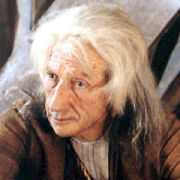
| Dojjen |
| Preston Lockwood |
| Lon |
| Martin Clunes |
| Dugdale |
| Brian Miller |
| Fortune Teller |
| Hilary Sesta |
| Hawker |
| George Ballantine |
| Chela |
| Johnathon Morris |
| Puppeteer |
| Barry Smith |
| Megaphone Man |
| Brian Grellis |
Crew
| Written by |
| Christopher Bailey (bio) |
| Directed by |
| Fiona Cumming (bio) |
|
| Incidental Music |
| Peter Howell |
| Special Sound |
| Dick Mills |
| Production Manager |
| Margot Hayhoe |
| Production Associate |
| Angela Smith |
| Production Assistant |
| Rita Dunn |
| Assistant Floor Manager |
| Maggy Campbell |
| Film Cameraman |
| John Baker |
| Film Sound |
| Ron Blight |
| Film Editor |
| Alastair Mackay |
| Visual Effects Designer |
| Andy Lazell |
| Video Effects |
| Dave Chapman |
| Technical Manager |
| Derek Thompson |
| Senior Cameraman |
| Alec Wheal |
| Geoff Clark |
| Vision Mixer |
| Carol Johnson |
| Videotape Editor |
| Rod Waldron |
| Studio Lighting |
| Henry Barber |
| Studio Sound |
| Martin Ridout |
| Costume Designer |
| Ken Trew |
| Make-up Artist |
| Marion Richards |
| Script Editor |
| Eric Saward (bio) |
| Title Sequence |
| Sid Sutton |
| Designer |
| Jan Spoczynski |
| Producer |
| John Nathan-Turner (bio) |
|