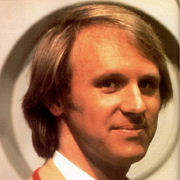
| Season Nineteen (1982): Mortal
Reminders |
|
Following Christopher H Bidmead's departure from Doctor Who at
the end of its eighteenth season, Antony Root
(bio) became the interim
script editor. When Root's training continued on another programme, he
was replaced by Eric Saward (bio), who was already writing for the
upcoming season. Root decided not to return to Doctor Who, and so
Saward's appointment was made permanent.
|
|
|
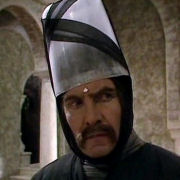
Castrovalva by Christopher H Bidmead,
directed by Fiona Cumming
In the TARDIS, the Doctor's regeneration is failing. He retreats to the
tranquil environment of the Zero Room, little realising that he is
snared in a trap set by the Master. The evil Time Lord has kidnapped
Adric, and used a facsimile of the boy to send the TARDIS hurtling back
in time, to be torn apart in the Big Bang. The desperate solution to the
situation results in the destruction of the Zero Room, so Tegan directs
the TARDIS to the mountaintop city of Castrovalva, legendary for its
serenity. There she hopes the Doctor will be able to recuperate from his
recent trauma... but has the Master laid a trap with a trap?
|
|
|
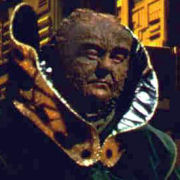
Four To Doomsday by Terence Dudley,
directed by John Black
The Doctor tries to get Tegan home, but instead lands the TARDIS on a
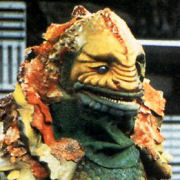
spaceship which is four days from Earth. He meets the frog-like Monarch
from the ruined planet Urbanka, who explains that the ship carries three
billion Urbankan refugees. But Monarch has visited the Earth four times
in the past, and the vessel is also home to representatives of the
ancient cultures of Australia, China, Greece and the Mayan Empire.
However, as the time travellers explore, they soon realise that
something about the humans is not right. And they grow suspicious that
Monarch's benevolent facade masks sinister intentions.
|
|
|
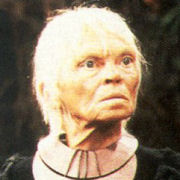
Kinda by Christopher Bailey, directed by
Peter Grimwade
The TARDIS lands on the idyllic jungle world of Deva Loka, where a
survey team from Earth is assessing the planet for colonisation.
Sanders, the expedition commander, has kidnapped two of
the Kinda -- the apparently primitive native people of Deva Loka, who
are led by the ancient prophetess Panna. But now the rest of the Kinda
have turned against the humans, some of the team has gone missing, and
security chief Hindle is descending into madness. To make matters worse,
a sleeping Tegan finds herself in a nightmarish void, where her only
escape is to become the vessel for an ancient evil which calls itself
the Mara...
|
|
|
The Visitation by Eric Saward, directed
by Peter Moffatt
It is the year 1666, and the Great Plague runs rampant throughout
England. In a small village, the Doctor, Adric, Nyssa and Tegan find the
townsfolk behaving in an odd, hostile manner. Unemployed thespian
Richard Mace tells them that a comet was recently sighted in these
skies, and the Doctor suspects that it was actually a spaceship. Soon,
the time travellers discover the presence of fugitive Terileptils, who
are performing experiments on rats in the concealed basement of a manor
house. The aliens have taken control of the villagers' minds, while
their lethal android stalks the countryside dressed as the Grim Reaper.
|
|
|
Black Orchid by Terence Dudley, directed
by Ron Jones
In 1925 England, a case of mistaken identity leads the Doctor to join a
charity cricket match organised by the wealthy Cranleigh family. Nyssa
discovers that Lord Charles Cranleigh's fiancee, Ann Talbot, is her
exact double. Enchanted with the time travellers, the Cranleighs invite
them to a masquerade ball that evening. There, Tegan learns of the
tragic loss of Charles' elder brother, George, on a botanical expedition
to South America. Meanwhile, the Doctor discovers a dead body hidden
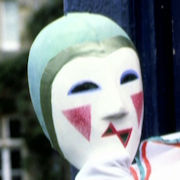
beyond a secret passageway. Having stolen the Doctor's harlequin
costume, the killer now stalks the party, intent on Ann.
|
|
|
Earthshock by Eric Saward, directed
by Peter Grimwade
In a cave complex on twenty-sixth-century Earth, the Doctor, Adric,
Nyssa and Tegan come to the aid of a platoon of soldiers, who have been
attacked while investigating the deaths of several scientists. The
Doctor discovers that the killers are actually androids, left to guard a
massive bomb capable of destroying the planet. The Doctor disarms the
explosive with Adric's help. He traces the detonation signal to a
deep-space freighter where recent disappearances amongst the crew have
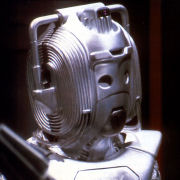
baffled Captain Briggs. The true culprits are the Cybermen, whose plot
against the Earth will have devastating consequences...
|
While foiling the Cybermen's plans, Adric dies when the freighter
explodes.
|
|---|
|
|
|
Time-Flight by Peter Grimwade, directed
by Ron Jones
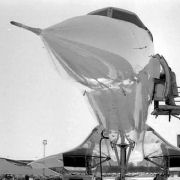
The TARDIS materialises at modern-day Heathrow Airport, where a Concorde
airplane has just vanished from the skies. The Doctor, Nyssa and Tegan
offer to help, and they board a second Concorde which follows the same
flight path as the first. They discover a time corridor which propels
them back to the Pleistocene Era. There they find that the first
Concorde's crew and passengers have been enslaved by the sinister
sorcerer Kalid, who is forcing them to excavate a sanctum within a
mysterious citadel. An alien intelligence takes possession of Nyssa,
warning the Doctor of the great peril that awaits him within.
|
|
For the first time ever, Doctor Who was moved out of its
traditional Saturday evening timeslot and instead aired twice-weekly --
on both Monday and Tuesday nights -- during Season Nineteen. This change
was prompted by the drastic drop in ratings of the previous year, an
erosion which was largely reversed with the new schedule and the new
Doctor.
|
| Season Twenty (1983): Old Ghosts |
| Companions and Recurring Characters |
|
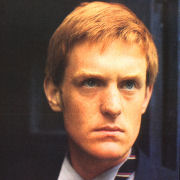
Vizlor Turlough was an alien from the
planet Trion who was imprisoned on Earth, and became a member of the
TARDIS crew while acting as an agent of the sinister Black Guardian.
Mark Strickson (bio) made his first appearance as
Turlough in Mawdryn Undead
(February 1983) and his last in The Caves
Of Androzani (March 1984).
|
|
|
|
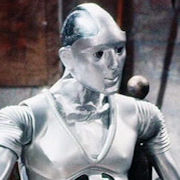
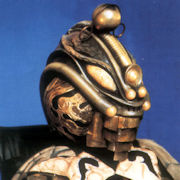
Kamelion was a shape-shifting android whom
the Doctor rescued from the clutches of the Master.
Kamelion appeared between The King's
Demons (March 1983) and The Caves
Of Androzani (March 1984). Its default voice was provided by
Gerald Flood (bio).
|
|
|
|
|
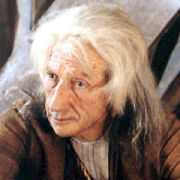
Arc Of Infinity by Johnny Byrne,
directed by Ron Jones
On Gallifrey, the Doctor's bio-data extract is stolen from the Matrix
while, in Amsterdam, Tegan Jovanka's cousin goes missing after an
encounter with something alien. When a being from an anti-matter
universe begins to genetically bond with the Doctor, the TARDIS is
summoned back to Gallifrey. There, the High Council orders the Doctor's
execution, as a means of preventing the anti-matter entity from usurping
the Matrix. Suspecting a traitor amongst the High Council, it falls to
Nyssa to save her friend... while, on Earth, Tegan becomes enmeshed in
the cosmic web of revenge which connects all of these events.
|
|
|
Snakedance by Christopher Bailey,
directed by Fiona Cumming
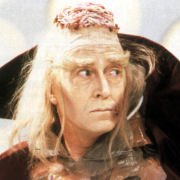
Five centuries ago, Manussa was the seat of the Mara's empire. There it
was seemingly destroyed by the Great Crystal, but was really only
banished into dreams. Now many Manussans consider the Mara to be little
more than a fairytale, while it has been patiently awaiting the
opportunity to restore its power. Seizing control of Tegan's mind, the
Mara compels her to direct the TARDIS to Manussa. There she corrupts
Lon, the Federator's son, who will be the vessel for the Mara's return.
With few besides the Snakedancers in the hills standing guard against
the Mara, only the Doctor can prevent its return and save his companion.
|
|
|
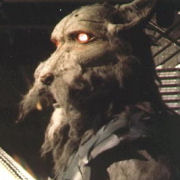
Mawdryn Undead by Peter Grimwade,
directed by Peter Moffatt
Retired from UNIT, Brigadier Lethbridge-Stewart now teaches maths at a
boys' boarding school where one of the pupils, Turlough, is secretly an
alien. The Black Guardian convinces Turlough to kill the Doctor, and
directs him to a concealed transmat capsule. It leads to a spaceship,
deserted except for the TARDIS. The Doctor accompanies Turlough back to
Earth, and is shocked to discover that the Brigadier has forgotten him.
Tegan and Nyssa try to follow in the TARDIS, but find themselves
arriving seven years too early. There they meet not only the Brigadier,
but also a horribly burned man who claims to be the Doctor.
|
Under orders from the Black Guardian, Turlough joins the Doctor.
|
|---|
|
|
|
Terminus by Steve Gallagher,
directed by Mary Ridge
Turlough sabotages the TARDIS, resulting in the appearance of a doorway
which leads to an ageing spaceship. There the time travellers encounter
the pirates Kari and Olvir, who realise that the vessel is carrying
victims of the fatal and virulent Lazar disease. The ship docks at
Terminus, a space station where the weary Vanir care for the Lazars in
the last days of their lives. Soon Nyssa begins to succumb to the
plague, while the Doctor discovers that Terminus lies at the exact
centre of the universe. Meanwhile, in the heart of the Forbidden Zone,
guarded by the mysterious Garm, waits an ancient and terrible secret...
|
Nyssa decides to stay on Terminus to help treat the Lazar victims.
|
|---|
|

|
|
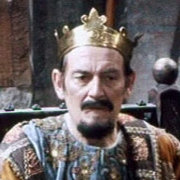
Enlightenment by Barbara Clegg, directed
by Fiona Cumming
Under the failing influence of the White Guardian, the TARDIS
materialises aboard a spacecraft disguised as an Edwardian racing yacht.
Its captain, Striker, is competing in a race across the solar system. He
and his officers are Eternals -- immortal beings incapable of creative
thought -- while the sailors are “ephemerals”, mortals whose
minds give the Eternals sustenance. Tegan attracts the interest of the
first mate, Marriner, while the Doctor suspects that one of the Eternals
is cheating to win the mysterious prize of Enlightenment. Meanwhile,
Turlough begins to realise that there may be no escape from the Black
Guardian...
|
|
|
The King's Demons by Terence Dudley,
directed by Tony Virgo
The TARDIS brings the Doctor, Tegan and Turlough to the castle of Ranulf
Fitzwilliam, in 1215 England. Also present are King John and his
champion, Sir Gilles Estram, who have accused Ranulf of failure to
provide adequate financial support to the throne. The Doctor is baffled
-- not just because King John is meant to be in London, involved in the
events which will lead to the signing of the Magna Carta, but also
because he is strangely unperturbed by the arrival of the TARDIS. Soon
the evidence mounts that the king is an impostor. But who is really
pulling the strings, and to what end?
|
The Doctor invites the shape-changing robot Kamelion into the TARDIS.
|
|---|
|
|
Each story of Season Twenty saw the return of an element from Doctor
Who's past, a coincidence noticed by Ian Levine -- who was then acting
as the programme's unofficial fan adviser -- and used for publicity
purposes by John Nathan-Turner. Characters brought back from previous
years included Omega, the Mara, Brigadier Lethbridge-Stewart (whose role
in Mawdryn Undead was originally
written for Ian Chesterton), the Black and White Guardians, and the
Master. The list should have included the Daleks as well, but industrial
action forced the cancellation of the planned season finale. It was
ultimately made as Resurrection Of The
Daleks the following year.
|
| Special (1983): Many Happy
Returns |
|
|
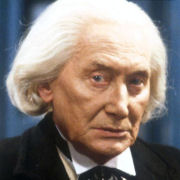
The Five Doctors by Terrance Dicks,
directed by Peter Moffatt
While the Fourth Doctor is trapped in a time vortex, the First, Second
and Third Doctors are drawn to the forbidden Death Zone on Gallifrey,
together with many of their companions. They are joined by the Fifth
Doctor, who is fading from existence. The Doctors journey towards the
Dark Tower at the heart of the Death Zone, encountering some of their
deadliest foes en route -- including the Master, who has been recruited
by the High Council. When the Fifth Doctor teleports himself to the
Capitol, he uncovers evidence of a traitor amongst the Time Lord elite.
All are embroiled in the Game of Rassilon, whose prize is immortality
itself.
|
|
Celebrating Doctor Who's twentieth anniversary, The Five Doctors was broadcast eight
months after the conclusion of Season Twenty. The special episode
featured all five Doctors -- although Tom Baker was confined to clips
from the unfinished Shada, and the
late William Hartnell appeared only in an excerpt from The Dalek Invasion Of Earth, with the
First Doctor otherwise played by Richard Hurndall. They were joined by
eleven companions (Susan, Jamie McCrimmon, Brigadier Lethbridge-Stewart,
Zoe Heriot, Liz Shaw, Mike Yates, Sarah Jane Smith, K·9, Tegan
Jovanka and Turlough, with Romana also being represented via clips from
Shada) and four old enemies (the
Master, the Cybermen, a Dalek, a Yeti), in addition to the Time
Lords.
|
| Season Twenty-One (1984): Violent
Times |
| Companions and Recurring Characters |
|
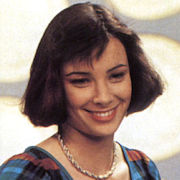
Perpugilliam (Peri) Brown was an American
college student who became embroiled in the Master's scheme to seize the
power of the numismaton flames on the planet Sarn.
Nicola Bryant (bio) made her first appearance as
Peri in Planet Of Fire (February
1984) and her last in Dimensions In
Time (November 1993).
|
|
|
|
|
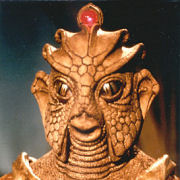
Warriors Of The Deep by Johnny Byrne,
directed by Pennant Roberts
In 2084, the TARDIS materialises in an underwater seabase, operated by
one of two power blocs waging a bitter cold war. It has been infiltrated
by enemy agents Solow and Nilson, who are planning to use the
brainwashed Maddox to cripple its offensive capabilities. Meanwhile,
Commander Vorshak is contending with the appearance of an unidentified
object travelling towards the seabase. The Doctor recognises it as a
Silurian cruiser. To support their invasion of the seabase, the ancient
reptiles have reawakened not only a platoon of their Sea Devil cousins,
but also the rampaging terror known as the Myrka.
|
|
|
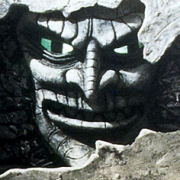
The Awakening by Eric Pringle, directed
by Michael Owen Morris
The Doctor and Turlough accompany Tegan to the village of Little
Hodcombe. She plans to visit her grandfather, Andrew Verney, but learns
that he has gone missing. The villagers, led by Sir George Hutchinson,
are re-enacting events from 1643, when the English Civil War came to
Little Hodcombe. But now strange apparitions are haunting the village,
and the Doctor finds Wil Chandler, an urchin from 1643, hiding in the
ruined church. Little Hodcombe has come under the influence of an alien
entity called the Malus -- and when Tegan is chosen to be the Queen of
the May, she may become its next victim.
|
|
|
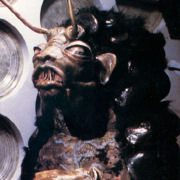
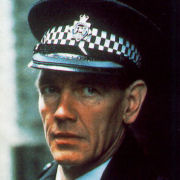
Frontios by Christopher H Bidmead,
directed by Ron Jones
The TARDIS arrives on the planet Frontios, where the last vestiges of
humanity crashlanded years earlier. Now the colony struggles to survive
under constant meteorite bombardment. To make matters worse, people are
going missing -- and the colony leader, Captain Revere, seems to have
been sucked down into the ground. When even the TARDIS is apparently
destroyed, the Doctor becomes determined to get to the bottom of the
mystery. Lurking beneath the colony are the Gravis and his Tractators --
creatures so terrible that Turlough is paralysed by latent memories of
the devastation they inflicted on his ancestors.
|
|
|
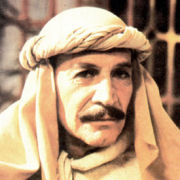
Resurrection Of The Daleks by Eric
Saward, directed by Matthew Robinson
The TARDIS is nearly torn apart in a time corridor. The Doctor and Tegan
explore one end: a warehouse on modern-day Earth, where they find an
escapee from the Daleks named Stien. At the other end, Turlough is on a
Dalek battleship, which is invading a space station in the future. A
bomb disposal squad arrives at the warehouse, and the Doctor helps them
investigate some mysterious cylinders. On the space station, the
mercenary Lytton intends to free the imprisoned Davros. The Daleks have
lost their war with the Movellans due to a virus which afflicts only
their kind... and they intend to rescue Davros so that he can create a
cure.
|
Tired of the death and violence she has witnessed, Tegan remains on
Earth.
|
|---|
|
|
|
Planet Of Fire by Peter Grimwade,
directed by Fiona Cumming
Kamelion is malfunctioning when the TARDIS picks up a distress signal
emanating from modern-day Lanzarote. Archaeologist Howard Foster has
found a strange artefact which is taken by his step-daughter, Peri
Brown. When Turlough saves Peri from drowning and brings her aboard the
TARDIS, the Doctor realises that the artefact is emitting the signal. It
propels the TARDIS to the planet Sarn, where Kamelion falls under the
sway of the Master, and convinces Chief Elder Timanov that he is a
divine emissary. Meanwhile, Turlough finds evidence of a mysterious
connection between Sarn and his homeworld of Trion.
|
Turlough returns to Trion and the Doctor destroys Kamelion at the
robot's request, while Peri travels on in the TARDIS.
|
|---|
|
|
|
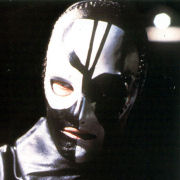
The Caves Of Androzani by Robert Holmes,
directed by Graeme Harper
On Androzani Minor, the Doctor and Peri are mistaken for gunrunners and
captured by General Chellak. Employed by Morgus, a powerful businessman,
Chellak and his troops are trying to flush out the masked Sharaz Jek and
his army of androids. At stake is a priceless supply of life-prolonging
spectrox. Jek rescues the Doctor and Peri from execution, and they learn
that he was betrayed by Morgus long ago, resulting in his disfigurement.
But they also discover that they have contracted lethal spectrox
toxaemia poisoning -- and it becomes clear that the Doctor will never
find a cure in time to save both Peri and himself.
|
His body irreparably damaged by spectrox toxaemia, the Doctor
regenerates.
|
|---|
|
|
After a period of relative stability, Doctor Who saw a complete
turnover in its cast during the three-story period from Resurrection Of The Daleks to The Caves Of Androzani. The Fifth
Doctor, Tegan and Turlough all made their exit, while the Kamelion robot
was also hastily written out due to ongoing problems with its
functionality. It would be the Sixth Doctor and Peri who would take
Doctor Who into the mid-Eighties, and a period of unprecedented
turmoil...
|
|