| Previous Story: Planet Of The Daleks | Next Story: The Time Warrior |
|
Serial TTT · Classic
Series Episodes 350 – 355: The Green Death
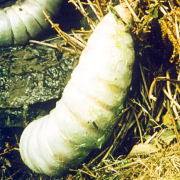
While the Doctor explores the planet Metebelis Three, Jo and the Brigadier travel to the Welsh village of Llanfairfach. Lethbridge-Stewart is investigating reports of a dead miner whose corpse glowed green, while Jo is interested in the work of Professor Jones, an ecologist who has established the nearby Wholeweal community. The Brigadier is rebuffed by Stevens, the director of Global Chemicals, who receives orders from a mysterious boss. Convinced by Jones that Global's waste is poisoning the local mine, Jo investigates. She discovers that it is crawling with insects -- mutated into giant, green monsters.
By early 1972, Doctor Who producer Barry Letts and script editor Terrance Dicks were becoming increasingly concerned with environmental issues. Letts, in particular, had been roused by an article entitled “A Blueprint For Survival”, published by Edward Goldsmith in the magazine The Ecologist. He and Dicks felt that Doctor Who provided an opportunity to tell a positive message about protecting the environment and the dangers of pollution. In an April planning document for Doctor Who's tenth season, Letts suggested the inclusion of an adventure called “The Amoeboids”, in which Earth's pollution attracted giant, omnivorous alien insects. Letts pondered the involvement of the Royal Air Force to help achieve effects involving massive, flying monsters. By the autumn, however, Letts' ideas for the serial had become more modest, and now involved mutated Earth insects emanating from a coal mine. He again sought the services of his friend, Robert Sloman, with whom he had most recently worked on The Time Monster for Season Nine. Letts hoped to develop a narrative which demonstrated the importance of balancing industrial development and environmental concerns, rather than just serving as an anti-capitalist tract. He and Dicks were also aware that the scripts could not be overtly political, lest Doctor Who be accused of fomenting opposition to Ted Heath's Conservative government.
For his part, Sloman drew upon the environmental activism of Greenpeace, which had recently been formed in Canada, as well as the Biotechnic Research And Development (BRAD) community in Wales. Sloman was working on his storyline by October, and The Green Death was commissioned on November 30th. For the third year in a row, Sloman would contribute the Doctor Who season finale. The main villain, Stevens, was named after Jocelyn Stevens, formerly Sloman's superior in the newspaper industry. Meanwhile, Letts had had a discussion with Katy Manning about her future playing Jo Grant on Doctor Who, and the actress had indicated that she was considering leaving the show at the end of the year. Letts agreed that remaining any longer might be to the detriment of Manning's career; he also suspected that Jon Pertwee might be departing Doctor Who after another year, and he did not want his two stars quitting simultaneously. By January 1973, Letts and Manning had agreed that The Green Death would be Jo's final serial. Sloman was asked to amend his storyline to incorporate her decision to marry Professor Clifford Jones. This character would be written as a younger version of the Doctor -- the only type of person for whom the production team could envisage Jo leaving the United Nations Intelligence Taskforce (UNIT). Sloman's scripts went through a variety of other, more minor modifications. Universal Chemicals became United Chemicals and then, because such a firm actually existed, Global Chemicals. Similarly, Charles Bell was renamed Ralph Fell to avoid confusion with a real-life petroleum company executive. A Wholeweal member nicknamed “Face” was excised, and the relevant dialogue instead allocated to Nancy. The reference to the Prime Minister as “Jeremy” came at Letts' instigation -- partly to avoid offending Ted Heath, and partly because the producer hoped that Jeremy Thorpe, the leader of the Liberal Party, would win the next UK General Election. On March 6th, Richard Franklin was contracted to play Captain Yates, and John Levene was booked as Sergeant Benton two days later. It was briefly thought that Yates' role in the latter stages of The Green Death might instead be given to Benton, but this idea was not pursued. Nicholas Courtney, meanwhile, was belatedly contracted to play the Brigadier on March 14th, by which time filming had already begun. The director assigned to The Green Death was Michael Briant, who had last worked on The Sea Devils the previous year. Amongst the casting suggestions made to Briant for the role of Clifford Jones was Stewart Bevan, then Manning's real-life boyfriend. Briant was reluctant to invite Bevan to audition, fearing the on-set ramifications -- especially considering how upset Pertwee had become when he learned that Manning was leaving Doctor Who. However, Bevan ultimately proved to be the only suitable choice for the role. The Welsh location schedule for The Green Death was unusually hectic, and so Briant assembled a second unit for close-ups and establishing shots, directed by production assistant John Harris. Filming began on March 12th around the Troed-y-Rhiw Jestyn farm, for material on the road and at Wholeweal. The second half of the day was devoted to scenes in and around the mine. They were recorded at Ogilvie Colliery in Deri, where worked continued until the 15th. Part of March 13th was also spent at the nearby Colliery Quarry, which served as Metebelis Three. During the Ogilvie material, John Levene ad-libbed Benton's reference to two UNIT soldiers as “Dicks” and “Betts” in honour of the production team. Filming concluded with three days -- March 16th, 19th and 20th -- at the RCA International factory at Brynmawr, which served as the Global Chemicals building. In between, on the 17th, model filming was conducted at the BBC Television Film Studios in Ealing, London. Studio recording took place in fortnightly two-day blocks at BBC Television Centre Studio 3 in White City, London. The first two sessions were held on Mondays and Tuesdays. Episode One was taped on April 2nd; originally, Mitzi McKenzie was intended to appear as Nancy in the scene where Jo met Clifford Jones, but the material had to be rewritten at the last minute when she proved unavailable. April 3rd was devoted to Episode Two, as well as the lone Episode Three sequence set in the pit head office. The remainder of the third installment was then recorded on April 16th. Amongst the members of Wholeweal, Jessie was played by a real flautist named Jessica Stanley Clarke. She was also a member of the prog-rock band Marsupilami, who had once toured with Deep Purple; later known as Jekka McVicar, she became a well-known expert on organic gardening. The majority of Episode Four was completed on the 17th. At a late stage, the BBC Planning Department brought the third studio block forward by one day, meaning that it was held on a Sunday and a Monday: April 29th and 30th. Episode Five was recorded on the Sunday, together with the material in the computer room for Episode Four. Unfortunately, Tony Adams was unable to play Elgin on these dates, having developed peritonitis. The script for Episode Five was hastily rewritten to replace Elgin with a new character, Mr James, played by frequent Doctor Who supporting artiste Roy Skelton.
Episode Six was then taped on April 30th, bringing Katy Manning's time on Doctor Who to a close. This marked the beginning of the end for the so-called UNIT family, which had been together since the start of Season Eight. It was an emotional day for the cast, but there was little time to reflect for Pertwee and Courtney, who would go right back into production on The Time Warrior, which was being held over to start Season Eleven. Manning's decision was announced to the public on June 22nd. For much of Season Ten, Doctor Who's ostensible lead-in, apart from an intervening news update, was We Want To Sing. On two occasions, however, The Green Death was instead preceded by other programming. On May 19th, Episode One followed an extended edition of Grandstand, which featured an England versus Scotland football match. Then, on June 16th, the lead-in for Episode Five was Beating Retreat, a birthday tribute to Prince Philip by the Royal Marines. The following week, Episode Six brought Doctor Who's tenth season to a close. The anniversary season had continued to bring large audiences to the show. But, as Jo Grant headed off to the Amazon and the Doctor drove away into the sunset, it was clear that, although Doctor Who had been enjoying a prolonged period of stability, this was now coming to an end...
|
|
||||||||||||||||||||||||||||||||||||||||||||||||||||||||||||||||||||||||||||||||||||||||||||||||||||||||||||||||||||||||||||||||||||||||||||||||||||||||||||||||||||||
| Updated 20th August 2020 |
| Return To | ||
|---|---|---|
| Main Page | Episode List | Season 10 |
| Previous Story: Planet Of The Daleks | Next Story: The Time Warrior |