| Previous Story: The Masque Of Mandragora | Next Story: The Deadly Assassin |
|
Serial 4N · Classic
Series Episodes 432 – 435: The Hand Of Fear
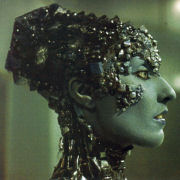
The TARDIS lands in a quarry, where an explosion buries Sarah under rock. When the Doctor rescues her, she is unconscious and clutching a calcified hand. After awakening at the hospital, Sarah begins acting strangely: the hand is all that remains of a silicon-based alien called Eldrad, whose consciousness has seized control of Sarah's mind. Eldrad compels her to break into a nearby nuclear complex and send the reactor into meltdown. Even if the Doctor is able to avert a radioactive catastrophe, can he save Sarah and put a stop to Eldrad's ancient plans?
Some months after writing The Sontaran Experiment in mid-1974, Bob Baker and Dave Martin began to work on new ideas for Doctor Who. With producer Philip Hinchcliffe and script editor Robert Holmes eager to continue mining horror movie tropes for story ideas, the scriptwriting duo agreed to develop a storyline involving a murderous hand that could move on its own, such as in the 1946 film The Beast With Five Fingers. In particular, Holmes pointed Baker and Martin towards Maurice Renard's 1920 novel Les mains d'Orlac, which had mostly recently been adapted for the screen in 1960 as The Hands Of Orlac starring Christopher Lee. It concerned an amputee who received new hands which had originally belonged to a murderer, and which now induced him to kill as well. In addition, Hinchcliffe and Holmes were in the process of winding down the involvement of the United Nations Intelligence Taskforce (UNIT), which had been a key component of the Doctor Who format for more than five years. It was suggested that Baker and Martin's story might be an opportunity for the Doctor's longtime ally, Brigadier Lethbridge-Stewart, to go out in a blaze of glory; this had also been an element considered for 1975's Pyramids Of Mars. Notions that Baker and Martin wished to explore included the phenomenon of people who wanted to escape modern technology and get back to nature, as well as the presence of a completely ruthless, bloodless villain. Indeed, they decided to take the latter concept literally by pitting the Doctor and the Brigadier against a silicon-based lifeform, made completely out of stone.
On May 29th, 1975, Baker and Martin submitted an outline for a six-part story called “Hand Of Fear”; it may have also gone by the titles “The Hand Of Time” and “The Hand Of Death”. The setting was the 1990s, at a time when technology and the military were prohibited. Sarah was sent to live in a commune while the Doctor was relegated to a labour camp. There he met the aged Brigadier -- now part of EXIT, the Extraterrestrial Xenological Intelligence Taskforce -- and learned of an anthropologist named Mountford, who had unearthed a mysterious fossilised hand. The hand took control of Mountford's mind and forced him to transport it to the Nuton nuclear reactor (previously seen in Baker and Martin's 1971 story The Claws Of Axos), which was in the process of being decommissioned. There, radiation allowed the hand to regenerate into its original form: a creature called an Omegan, made of teryllium, which had crashlanded on Earth after its journey from the interior of a black hole. It transpired that there were actually two Omegans at work on Earth, representing different factions of their people. While the “hawk” Omegans wished to destroy humanity, the “dove” Omegans simply wanted to nullify mankind's potential to become an interstellar threat. They were in the process of accomplishing this by slowly devolving people into ape-like Trogs, and this was initially manifested as a backlash against science. Sarah was now enduring the same regression. This was undone, however, when the “hawk” Omegan destroyed his “dove” counterpart. He then fled Earth in the other Omegan's spaceship, having configured Nuton to explode and obliterate the planet. At the last second, the Doctor managed to redirect the power of the blast to fuel an experimental rocket called the Icarus. Brigadier Lethbridge-Stewart commandeered the Icarus and used it to pursue the Omegan. Realising that the Omegan was planning to cause a global catastrophe by suicidally ramming his spaceship into the planet, the Brigadier sacrificed himself by forcing the Omegan to collide with the Icarus. On June 19th, Baker and Martin met with Hinchcliffe and Holmes to discuss their storyline. At this point, it was decided to do away with the near-future setting -- and hence the evolution of UNIT into EXIT -- as well as the Brigadier's demise. Nonetheless, the production team was pleased with “Hand Of Fear”, and the scripts were formally commissioned the next day. It was intended to serve as the final story of Season Thirteen, to be directed by Douglas Camfield.
Over the summer, Baker and Martin's narrative -- now given the slightly amended title of The Hand Of Fear -- continued to evolve. Lieutenant Hawker, who had been a central character in the original draft, was largely replaced with former companion Harry Sullivan. Along with the calcified hand, an Omegan spaceship referred to as “the Monolith” was now discovered at the start of Episode One and became central to the storyline, providing the location for the adventure's climax. The separate factions of Omegans were excised. Baker and Martin also introduced a new supporting character, in the form of a Time Lord named Drax. An untrustworthy Gallifreyan mechanic who wanted to steal the TARDIS to add to his collection, Drax was conceived as a possible recurring character for Doctor Who. As autumn loomed, however, Hinchcliffe and Holmes became concerned that the scripts for The Hand Of Fear still required a lot of work to iron out the convoluted plot. Holmes had been dedicating his efforts to a wholesale rewrite of The Brain Of Morbius, the penultimate serial of Season Thirteen, which prevented him from reviewing Baker and Martin's work until late September. With barely a month remaining before production was due to begin, Robert Banks Stewart was hastily commissioned to write The Seeds Of Doom as a replacement for The Hand Of Fear. On October 14th, Baker and Martin were formally notified that The Hand Of Fear had been dropped from Season Thirteen. The writers agreed to redevelop it for the following year and, for a time, it was eyed for the second-last slot of Season Fourteen. Around the time that production concluded on The Seeds Of Doom, Elisabeth Sladen informed Hinchcliffe that she wanted to leave Doctor Who early in the next block of stories. Sarah Jane Smith was about to become the programme's longest-serving companion, surpassing the three seasons of her predecessor, Jo Grant. (Sixties companion Jamie McCrimmon, however, would continue to hold the record for the most episodes.) Sladen thought it was time for new challenges, especially given that her commitments to Doctor Who were forcing her to turn down a variety of appealing work, including a movie. Meanwhile, Douglas Camfield had approached the production team about writing for Doctor Who. On January 22nd, 1976, Camfield was commissioned to write “The Lost Legion”, a four-part adventure set in a French Foreign Legion outpost which involved a campaign between two groups of aliens. It was agreed that, at the story's climax, Sarah would be killed by the last of the aliens, making her the first companion to die since 1966, when Katarina and Sara Kingdom both perished in The Daleks' Master Plan.
Although Hinchcliffe was enthusiastic about “The Lost Legion”, Holmes was more dubious, and his concern grew after Camfield delivered his first script on February 9th. In an ironic turnabout, Holmes decided that The Hand Of Fear should now be readied as a potential replacement for Camfield's serial. He issued a revised, four-part breakdown to Baker and Martin the same day, which removed UNIT and the de-evolution element. Also deleted was Drax, although Baker and Martin would revive the character for Season Sixteen's The Armageddon Factor. Baker and Martin formally agreed to write the truncated version of The Hand Of Fear on March 3rd. As work progressed on the new scripts for The Hand Of Fear, Camfield fell increasingly behind schedule on “The Lost Legion”. By the end of March, The Hand Of Fear was now on the schedule in its place. Baker and Martin left Sarah's departure for Holmes to write, but there were no longer plans to kill off the character. This decision met with Sladen's approval, since she had worried that such a turn of events would be very upsetting for Doctor Who's younger audience members. As it neared its completed form, The Hand Of Fear continued to undergo changes. In the same way that Eldrad's humanoid form was patterned after Sarah, the alien's speaking voice was originally intended to be based on Dr Carter's. Eldrad's race was renamed the Kastrians to avoid confusion with Omega, the villain of Baker and Martin's own 1972 adventure The Three Doctors. It was also decided that the nuclear complex featured in The Hand Of Fear should not be the same as the one seen in The Claws Of Axos after all, and so its name was amended slightly from Nuton to Nunton. Even now, Hinchcliffe was not entirely happy with The Hand Of Fear, which he felt lacked incident in its first two episodes and failed to give Sarah enough of a role to befit her final adventure. Unfortunately, Holmes was now completing his own scripts for the next story, The Deadly Assassin, and had no time left to spend massaging The Hand Of Fear. Although it had been planned for Camfield to direct his own script when “The Lost Legion” was still on the schedule, the same commitments which were contributing to the slow pace of his writing also precluded his availability as a director. Instead, Lennie Mayne was assigned to The Hand Of Fear; his most recent work had been on 1974's The Monster Of Peladon. Sadly, this would also be Mayne's final directorial outing for Doctor Who, as he would perish in a boating accident the following year. Filming for The Hand Of Fear began at the Amey Roadstone Company quarry in Cromhall, Gloucestershire on June 14th and 15th. This was a rare instance of a quarry actually appearing in Doctor Who as a quarry, rather than posing as some form of alien landscape. On June 16th, roadway material was recorded at a lay-by in Oldbury-on-Severn, Gloucestershire, while the gates of the Nunton Complex were actually those of the nearby Oldbury Power Station. Mayne's team then moved inside the facility on the 17th. Unusually, Baker and Martin had assisted in securing this location, which was very near to where they lived. Finally, on June 18th, Sarah's departure was filmed on Stokefield Close at Thornbury, Gloucestershire. Since Sladen felt that her whistling was inadequate, Mayne himself performed Daddy Wouldn't Buy Me A Bow Wow in her stead. His wife, Frances Pidgeon, handled the dog in this scene; she had also been cast as Miss Jackson, a character originally intended to be male. Production on The Hand Of Fear then moved to BBC Television Centre Studio 8 in White City, London, beginning with a three-day recording block from July 5th to 7th. Here Mayne dealt with all of the Earth-based scenes, completing each of the first three episodes per day. On the 6th, cast and crew were plagued by a persistent fly, which was noisy enough to interfere with the sound recording. The interloper was finally dealt with when Sladen inadvertently swallowed it while reciting her “Eldrad must live” mantra. The second studio session then took place on July 19th and 20th. Recording on the first day focussed on sequences in the TARDIS, as well effects shots of Eldrad's scuttling hand, model work, and some Kastria sequences, such as those in the observation dome and early Episode Four material in the lift and the corridor. For Sarah's departure from the TARDIS, Sladen and Baker rewrote much of their dialogue. The remaining Kastrian scenes from Episode Four were then taped on the second day. The 20th also brought Elisabeth Sladen's time as Sarah Jane Smith to a close... but not forever. Most of The Hand Of Fear was scheduled between 6.00 and 6.10pm, before Bruce Forsyth And The Generation Game. The only exception was Episode Two on October 9th. That evening, the new run of The Basil Brush Show -- replacing The Wonderful World Of Disney -- was given the spot directly after Grandstand, and the usual Tom And Jerry cartoon short was dropped. As such, Doctor Who aired at 5.50pm, following a news update. For the serial's final two installments, The Basil Brush Show was positioned between the news and Doctor Who.
|
|
||||||||||||||||||||||||||||||||||||||||||||||||||||||||||||||||||||||||||||||||||||||||||||||||||||||||||||||||||||||||||||||||||||||
| Updated 2nd January 2021 |
| Return To | ||
|---|---|---|
| Main Page | Episode List | Season 14 |
| Previous Story: The Masque Of Mandragora | Next Story: The Deadly Assassin |