| Previous Story: The Time Monster | Next Story: Carnival Of Monsters |
| Previous in Production: Frontier In Space | Next in Production: Planet Of The Daleks |
|
Serial RRR · Classic
Series Episodes 330 – 333: The Three Doctors
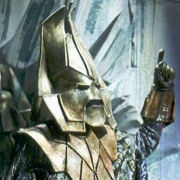
UNIT headquarters is attacked a strange form of energy which the Doctor believes has been sent to target him. He sends a distress signal to the Time Lords, but their power is being drained through a black hole -- from which the attack on the Doctor also emanates. The Time Lords are able to send the Second Doctor to assist the Third Doctor, while the First Doctor advises them from the TARDIS scanner. The Doctors allow the energy to teleport them through the black hole into a world of anti-matter. There they discover Omega, an ancient Time Lord long thought dead, who now wields absolute power over his new domain.
For each of the first three seasons in which Jon Pertwee played the Doctor, a strong “hook” had been present in the premiere adventure: Pertwee's debut in Season Seven's Spearhead From Space, the introduction of the Master in Season Eight's Terror Of The Autons, and the return of the Daleks in Season Nine's Day Of The Daleks. Once the BBC gave the go-ahead for Doctor Who's tenth season in early 1972, producer Barry Letts and script editor Terrance Dicks sought not only another compelling gimmick for the year's first story, but also one which would help celebrate the programme's anniversary. Letts had often been encouraged to develop a narrative in which Pertwee's Third Doctor met his two predecessors, played by Patrick Troughton and William Hartnell. In the past, Letts had dismissed this premise as lacking broad appeal, but he now concluded that a multi-Doctor story would be an excellent way to acknowledge Doctor Who's first decade. He and Dicks had also decided that it was time to dispense with the Doctor's exile to Earth, which had been imposed on the programme's format in 1969 by former producers Peter Bryant and Derrick Sherwin as a way of rejuvenating the appeal of Doctor Who while curbing costs. The show's audience had greatly expanded during Pertwee's tenure, and Letts and Dicks had already experimented with a handful of adventures in which the Doctor once again travelled in the TARDIS. The production team now agreed that the anniversary story would provide an appropriate opportunity to end the Doctor's exile altogether.
Dicks discussed the project with Bob Baker and Dave Martin as they completed work on The Mutants for Season Nine. On February 3rd, Baker and Martin submitted an idea called “Deathworld”, in which the Time Lords were in conflict with a Federation of Evil led by a personification of Death. To avert all-out war, the Time Lords convinced the Federation to allow them to send the three Doctors into the Federation's Limbo-like Underworld domain. There, the Doctors battled various representations of Death -- including zombies, the Four Horsemen of the Apocalypse, the Hindu goddess Kali, and the cyclops Polyphemus from Greek mythology -- with the victor in the contests determining whether the Time Lords or the Federation of Evil would prevail. Meanwhile, the production office contacted both Hartnell and Troughton to confirm their interest in returning to Doctor Who. Despite having been critical in the press of the programme's latter-day direction, Hartnell -- who had virtually retired from acting due to the debilitating arteriosclerosis which had influenced his decision to leave Doctor Who in 1966 -- was quick to accept the offer. Troughton also agreed, but he indicated that he would not be available until November. Consequently, it was decided that the anniversary adventure would be made second in the tenth recording block, following the season's third story, Frontier In Space. Carnival Of Monsters, slated to be the second serial in the broadcast order, had already been taped as part of the ninth production block. Pertwee was also approached to ensure he approved of the return of his predecessors; he gave his consent, with the condition that his Doctor remain the primary focus. On March 8th, Baker and Martin were directed to start work on a revised storyline. The main enemy became Ohm -- so named because “OHM” read upside-down is “WHO”, reflecting the writers' desire for their villain to be seen as the Doctor's opposite number. However, Letts was then contacted by Hartnell's wife, Heather, to provide a more thorough picture of the actor's health. While Hartnell sometimes enjoyed very lucid days, as when Letts had spoken with him, the arteriosclerosis often had a devastating impact on his memory, such that he sometimes forgot that he had ever starred in Doctor Who, and became upset when he was approached for an autograph in relation to the series. As such, on April 13th, Baker and Martin were told to restrict the First Doctor's involvement in the narrative to brief scenes. Dicks also requested the inclusion of former companion Jamie McCrimmon, as played by Frazer Hines, and suggested a romantic subplot involving Jamie and Jo Grant. As the spring wore into summer, Letts and Dicks asked Baker and Martin to make further changes. Letts did not want the villain to be called Ohm (since “Doctor Who” was considered to be the name of the programme, not the name of its main character) and so he was rechristened Omega, after the final letter of the Greek alphabet. Letts also felt that the “deathworld” setting was inappropriate for Doctor Who, and worried that the mythological adversaries lacked credibility. The writers instead conceived a desolate planet on the other side of a black hole, and the monstrous Gell Guards -- spelled inconsistently and never named on-screen -- were introduced. The scripts were finally commissioned under the title The Three Doctors on June 27th.
Baker and Martin reimagined Hartnell's role so that the First Doctor featured heavily only in Episode Four, when he joined his two successors for a final confrontation with Omega. After consulting with Hartnell's wife, however, Letts and Dicks concluded that any amount of studio recording would be too arduous for the actor. Dicks therefore rewrote the scripts so that the First Doctor appeared only on the TARDIS scanner: material which could be pre-filmed in a single day. Hartnell and Troughton were both issued contracts on September 21st. It had now become clear that Frazer Hines would be unable to take a major role in The Three Doctors because of his obligations to the soap opera Emmerdale Farm. It was initially thought that Jamie's role would be given to Captain Mike Yates of the United Nations Intelligence Taskforce (UNIT), but actor Richard Franklin already had theatre commitments. As such, Sergeant Benton -- a character already familiar with the Second Doctor from 1968's The Invasion -- took Jamie's place, albeit without the romantic subplot. On September 25th, John Levene and Nicholas Courtney were contracted to play Benton and the Brigadier in The Three Doctors. For a time, it was hoped that Hines might be able to tape a brief cameo appearance for the story's conclusion. When this proved impossible to arrange, it was instead suggested that Wendy Padbury might appear as Zoe Heriot. These plans were apparently scuttled by Pertwee, who was concerned that too many returning characters might detract from the show's current cast. The story's title was changed to “The Black Hole” around the time that its director, Lennie Mayne, came on board. Mayne had worked on The Curse Of Peladon the year before. Production began on November 6th at the BBC Television Film Studios in Ealing, London. This day was spent on the fight between the Third Doctor and Omega's champion, as well as all of William Hartnell's material. To compensate for the actor's failing memory, his lines were written on cue cards from which he could read as he was filmed. His balance was also poor, and so he remained seated throughout. This turned out to be Hartnell's final acting performance prior to his death in April 1975. Location work for “The Black Hole” got under way in Rickmansworth, Hertfordshire on November 7th. Time was spent at three venues on this day: Ollis' cottage was really the Summerfield Bungalow, the weather balloon came to ground at Springwell Reservoir, and Omega's domain was the Harefield Lime Works. More filming at the quarry took place on the 8th and 9th. November 10th took the cast and crew to Halings House, a youth hostel in Denham Green, Buckinghamshire, for scenes set outside UNIT headquarters. Between November 14th and 16th, model filming took place at the BBC Television Centre Puppet Theatre in White City, London. As usual, “The Black Hole” was recorded in fortnightly two-day studio sessions on Mondays and Tuesdays. During rehearsals, there was some tension between Jon Pertwee and Patrick Troughton over the latter's tendency to ad-lib, which frustrated Pertwee's reliance on a precise delivery of the script. Troughton finally agreed to respect his colleague's way of working, in recognition of Pertwee's status as Doctor Who's current lead actor. Around this time, the serial's title reverted to The Three Doctors. The first studio block was held on November 27th and 28th in BBC Television Centre Studio 1. On the Monday, Mayne recorded all of Episode One, together with the Time Lord scene for Episode Three. A new TARDIS console room set, designed by Roger Liminton, made its debut on this day. It was more faithful to Peter Brachacki's original design than the version Tim Gleeson had developed several months earlier for The Time Monster, which had warped in storage. Most of Episode Two was taped on the Tuesday, along with the Time Lord sequences for Episode Four. The exception was material in Omega's stronghold, which was held over to the second studio session. This took place on December 11th and 12th in TC6. The Monday saw the completion of the two middle installments, while the Tuesday was devoted to Episode Four alone. Two and a half weeks later, on December 30th, the first episode of The Three Doctors led off Doctor Who's tenth season. It returned to its usual 5.50pm timeslot, which had generally been occupied by a repeat of the classics serial Last Of The Mohicans during the summer and, as in 1971, by Bruce Forsyth's Generation Game during the autumn. Doctor Who was once again preceded by The Basil Brush Show and a news update, while Episode One was followed by the finale of the nineteenth season of Dixon Of Dock Green. With Episode Two on January 6th, 1973, Doctor Who led into The Wonderful World Of Disney, as had been the case for much of Season Nine. On January 20th, almost twelve million viewers tuned in to watch the climax of The Three Doctors -- the show's biggest audience since the penultimate episode of The Web Planet in 1965. The Doctor had irrefutably earned his freedom to travel, once again, through all of space and time...
|
|
|||||||||||||||||||||||||||||||||||||||||||||||||||||||||||||||||||||||||||||||||||||||||||||||||||||||||||||||||||||||||
| Updated 17th August 2020 |
| Return To | ||
|---|---|---|
| Main Page | Episode List | Season 10 |
| Previous Story: The Time Monster | Next Story: Carnival Of Monsters |
| Previous in Production: Frontier In Space | Next in Production: Planet Of The Daleks |