| Previous Story: The Awakening | Next Story: Resurrection Of The Daleks |
|
Serial 6N · Classic
Series Episodes 609 – 612: Frontios
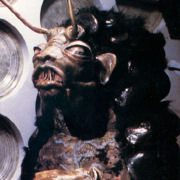
The TARDIS arrives on the planet Frontios, where the last vestiges of humanity crashlanded years earlier. Now the colony struggles to survive under constant meteorite bombardment. To make matters worse, people are going missing -- and the colony leader, Captain Revere, seems to have been sucked down into the ground. When even the TARDIS is apparently destroyed, the Doctor becomes determined to get to the bottom of the mystery. Lurking beneath the colony are the Gravis and his Tractators -- creatures so terrible that Turlough is paralysed by latent memories of the devastation they inflicted on his ancestors.
During the summer of 1982, former Doctor Who script editor Christopher H Bidmead was contacted by Eric Saward, his old job's current incumbent. As a writer, Bidmead had contributed 1981's Logopolis and 1982's Castrovalva, the serials which had bridged the change of lead actor from Tom Baker to Peter Davison. Saward now invited him to develop new story ideas for the programme's twenty-first season. Bidmead was happy to return to Doctor Who, but he was less keen on producer John Nathan-Turner's request for a monster-focussed adventure -- a significant departure from his earlier, more cerebral scripts. Despite his reservations, Bidmead conceived a storyline called “The Wanderers”, which was commissioned on August 24th. It introduced the Tractators, whose name was an anagram of “attractors” in reference to their gravity-controlling abilities. The Tractators' visual appearance was inspired by the wood lice which had infested a former residence of Bidmead's. The desolate setting was influenced by contemporary reports of shelling in Beirut during the 1982 Lebanon War. Bidmead also wanted to put the Doctor in a situation where he was very vulnerable, which suggested both the distant-future timeframe and the apparent destruction of the TARDIS.
On November 26th, Bidmead was contracted to provide the scripts for “Frotious”. This was one of several misspellings of the actual title Bidmead had coined for his serial: Frontios. Originally, Bidmead imagined Tractator technology as being constructed from the remains of the kidnapped colonists. This would have included both the excavation machine and a translation device which was intended to float beside the Gravis. These concepts were deemed too gruesome, however, and the notion was largely deemphasised. Saward rewrote the final scene of Frontios as a cliffhanger into the next adventure, his own Resurrection Of The Daleks. As “The Return”, this story had originally been planned to end Season Twenty, until industrial action forced its postponement. The serial that wound up serving as the twentieth-season finale, The King's Demons, was initially designed to lead directly into “The Return”, and Saward largely repurposed this material for Frontios. It replaced dialogue about a return visit to the Eye of Orion, where the Doctor, Tegan and Turlough had holidayed at the start of the anniversary special The Five Doctors. Frontios was assigned to director Ron Jones, who had most recently handled 1983's Arc Of Infinity. At his instigation, the Gravis' translation device was completely removed from the scripts; Jones feared that it might limit his selection of shots, and would require considerable effort while offering little substantive gain. Barrie Dobbins was given the job of designing Frontios. However, significant concerns arose regarding Dobbins' mental health, and so he was replaced by David Buckingham in early July. Sadly, Dobbins committed suicide soon thereafter. Dobbins' death was not the only tragedy which touched Frontios. As Mr Range, Jones cast veteran actor Peter Arne. On August 1st, he had his costume fitting for Doctor Who, and then returned home. Soon after, neighbours reported a violent argument in Arne's apartment, and the police arrived to find that he had been beaten to death. Several days later, a body was pulled from the Thames which was identified as that of a vagrant with whom Arne was acquainted. An inquest determined that the vagrant had murdered Arne and then drowned himself, although the motive was never made clear. Meanwhile, Jones hastily recast the role of Mr Range, with William Lucas taking Arne's place. Earlier in Season Twenty-One, costume woes had plagued Warriors Of The Deep, and similar issues resurfaced to bedevil Frontios as well. Bidmead had conceived the Tractators as being able to curl up into a ball, killing their victims by encircling and smothering them. With this in mind, Jones hired dancers and actors with a similar skill set to play the monsters. Unfortunately, the costumes developed by visual effects designer Dave Havard were very constrictive and inflexible, forcing Jones to reimagine how the Tractators would physically behave. Jones was also unhappy with Havard's design for the excavation machine, and decided to shoot around it as much as possible. Meanwhile, during rehearsals for Frontios on August 19th, the BBC announced that Colin Baker had been cast as the Sixth Doctor. In fact, Baker had agreed to replace Davison two months earlier.
Since the Doctor Who budget would be sorely taxed during the making of the next two serials -- the action-packed Resurrection Of The Daleks and Planet Of Fire, which would be recorded in Spain's Canary Islands -- it was agreed that money would be saved by confining Frontios entirely to the studio. As a result, Frontios was made in two three-day sessions at BBC Television Centre Studio 6 in White City, London. The first block spanned August 24th to 26th, and largely concentrated on the underground environments. Scenes in the medical shelter were also recorded on the last day. The second studio block took place from September 7th to 9th, and focussed on sequences in the human colony; Lucas was now battling the flu. The first day dealt with most of the exterior material. Some sequences on the hull of the colony ship were left over to the middle day, alongside those in the research room and the fractured TARDIS console room. Jones also had to make time for some footage in the tunnels which had been postponed from the first studio session. The TARDIS console room was made whole again for the final day of recording, which also dealt with scenes in the corridors of the colony ship and in the state room, alongside various effects shots. Jones wound up badly behind schedule, leaving little margin for error. At one point, Plantagenet actor Jeff Rawle put his foot through a step, and was astonished that the take was deemed acceptable. In post-production, it was found that Episode One was overrunning badly, forcing Jones to make a number of trims. Much of the excised material involved Cockerill, and explored his deepening sense of rebellion. Also dropped was a scene in which Tegan and Turlough returned to the TARDIS and found it surrounded by inquisitive colonists; this was why Turlough later quipped that the time travellers had lost their “news value”. Cut from Episode Three was the revelation that the voices of the Doctor and Tegan had echoed through the Tractators' tunnels, which explained how the Gravis was aware of the Doctor's intelligence. With the broadcast of Frontios Episode Two on January 27th, 1984, the BBC made a change to their Friday evening schedule. Doctor Who would now lead into The Superteams, instead of Match of The Day Live. Meanwhile, despite the difficulty in realising the Tractators, the monsters had proved popular with the Doctor Who production team. On March 5th, Saward wrote to Bidmead and proposed a new story which would team the Tractators with the Master. Nothing came of this idea, but Bidmead continued to work with Saward, developing “In The Hollows Of Time” and then “Pinacotheca”. Neither story would ultimately be produced, however, and Frontios became Bidmead's last televised Doctor Who serial.
|
|
|||||||||||||||||||||||||||||||||||||||||||||||||||||||||||||||||||||||||||||||||||||||||||||||||||||||||||||||||||||||||||||||||||||||||||||||
| Updated 17th June 2021 |
| Return To | ||
|---|---|---|
| Main Page | Episode List | Season 21 |
| Previous Story: The Awakening | Next Story: Resurrection Of The Daleks |