Serial Q · Classic Series
Episodes 68 – 71:
The Space Museum
The TARDIS lands at a space museum on the planet Xeros. The four
companions set out to explore, but quickly realise that something is
very odd: they leave no tracks, they can't touch anything, and nobody in
the museum reacts to their presence. When they find themselves displayed
as exhibits, the Doctor realises that they have jumped a time track, and
are glimpsing their own future. When time catches up with them, they
have no choice but to ally themselves with the native Xerons against the
warlike Moroks who rule the planet, if they're to have any hope of
averting their horrible destiny.
In 1964, Doctor Who story editor David Whitaker and South African
writer Glyn Jones met at a dinner party, where they discussed a play of
Jones' that Whitaker had recently enjoyed. Around the start of October,
Whitaker suggested that Jones consider contributing to Doctor
Who. At the time, Dennis Spooner was in the process of taking over
as story editor, and so it was he who commissioned Jones to write The
Space Museum. Jones was instructed to omit the Doctor from the third
episode, so that William Hartnell could take a week's vacation.
In developing his ideas, Jones called his villains Moroks as a play on
“moronic”, with Lobos' name suggested by the word
“lobotomy”. The Xerons were originally called Tharls,
drawing on an archaic term for a slave or servant from which the modern
“thrall” was derived. The cause of the time distortion was
originally a machine in the Morok processing room, rather than an issue
with a TARDIS component. After Jones submitted his scripts, he was
dismayed to learn that Spooner had excised much of the humorous
content. Although Spooner generally enjoyed incorporating comedy into
Doctor Who, he believed that jokiness would detract from the
high-concept premise of The Space Museum. He also wanted to make
sure that the season was made up of very distinct narratives.
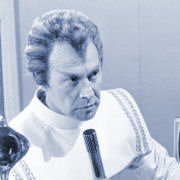
Mervyn Pinfield's cost-saving efforts on The Space Museum included a minimal filming
schedule
The director assigned to The Space Museum was Mervyn Pinfield
who, a few months earlier, had concluded his appointment as Doctor
Who's associate producer. During his tenure, Pinfield had also
directed some episodes, most recently the majority of Planet Of Giants. Pinfield was aware that
Spooner and producer Verity Lambert hoped to save money on The Space
Museum, to compensate for the strain that The
Web Planet had recently placed on the programme's resources, and
in anticipation of the expense of the next serial in production, The Chase. Pinfield's cost-saving efforts
included a minimal filming schedule at the BBC Television Film Studios
in Ealing, London. This encompassed just a single day -- March 11th,
1965 -- and chiefly dealt with model shots.
As The Space Museum was being prepared for recording in April, a
sea change was taking place in the Doctor Who production office.
Lambert had already declared her intention to leave the show at the
conclusion of the second recording block. Around the start of April, John
Wiles was appointed as her successor. At about the same time, Spooner
determined that he would not return to Doctor Who following the
expiry of his six-month contract, in favour of working with Dalek
creator Terry Nation on the high-profile adventure series The
Baron. Doctor Who's third story editor would therefore be
Donald Tosh. With the changeover in production team, Jacqueline Hill
concluded that she would depart Doctor Who in The Chase along with William Russell, who had
voiced the same decision some weeks earlier. The two stars' imminent
exit was announced to the press on April 1st.
Production on The Space Museum was originally planned to begin on
April 9th, skipping April 2nd, which was Good Friday. In the event, the
first episode did, in fact, go before the cameras on the 2nd; the
subsequent installments followed on consecutive Fridays. Unusually,
The Space Museum was recorded in Studio 4 at BBC Television
Centre in White City, London, rather than Doctor Who's usual home
of Riverside Studio 1. Amongst the limited guest cast was Peter Craze,
playing Dako; a year later, Craze's brother, Michael, would be cast as
companion Ben Jackson. On April 16th, Hartnell was absent from the
recording of The Search while enjoying his holiday.
The middle installments of The Space Museum both aired outside of
Doctor Who's usual 5.40pm timeslot. On May 1st, episode two was
scheduled fifteen minutes later to accommodate an extended edition of
Grandstand, which was highlighted by the FA Cup Final between
Leeds United and Liverpool. The following week, The Search was
pushed to 6.00pm by a celebration of the twentieth anniversary of VE
Day; this special broadcast also preempted Doctor Who's usual
lead-in, Juke Box Jury.
- Doctor Who Magazine #316, 1st May 2002, “Archive: The
Space Museum” by Andrew Pixley, Panini Publishing Ltd.
- Doctor Who Magazine Special Edition #7, 12th May 2004,
“I'm Into Something Good” by Andrew Pixley, Panini Publishing
Ltd.
- Doctor Who: The Complete History #5, 2016, “Story 15:
The Space Museum”, edited by John Ainsworth, Hachette Partworks
Ltd.
- Doctor Who: The Handbook: The First Doctor by David J Howe,
Mark Stammers and Stephen James Walker (1994), Virgin Publishing.
- Doctor Who: The Sixties by David J Howe, Mark Stammers and
Stephen James Walker (1992), Virgin Publishing.
|
|
Original Transmission
|
|
| 1: The Space Museum |
| Date |
24th Apr 1965 |
| Time |
5.41pm |
| Duration |
23'38" |
| Viewers (more) |
10.5m (16th) |
| Appreciation |
61% |
| 2: The Dimensions Of Time |
| Date |
1st May 1965 |
| Time |
5.55pm |
| Duration |
22'00" |
| Viewers (more) |
9.2m (23rd) |
| Appreciation |
53% |
| 3: The Search |
| Date |
8th May 1965 |
| Time |
6.00pm |
| Duration |
23'33" |
| Viewers (more) |
8.5m (22nd) |
| Appreciation |
56% |
| 4: The Final Phase |
| Date |
15th May 1965 |
| Time |
5.43pm |
| Duration |
22'15" |
| Viewers (more) |
8.5m (27th) |
| Appreciation |
49% |
Cast
| Dr Who |
| William Hartnell (bio) |
| Ian Chesterton |
| William Russell (bio) |
| Barbara Wright |
| Jacqueline Hill (bio) |
| Vicki |
| Maureen O'Brien (bio) |
| Sita |
| Peter Sanders |
| Dako |
| Peter Craze |
| Third Xeron |
| Bill Starkey |
| Xerons |
| Michael Gordon |
| Edward Granville |
| David Wolliscroft |
| Morok Guards |
| Lawrence Dean |
| Ken Norris |
| Billy Cornelius |
| Lobos |
| Richard Shaw |
| Tor |
| Jeremy Bulloch |
| Morok Messenger |
| Salvin Stewart |
| Morok Technician |
| Peter Diamond |
| Morok Commander |
| Ivor Salter |
| Dalek Voice |
| Peter Hawkins |
| Dalek Machine operated by |
| Murphy Grumbar |
Crew
| Written by |
| Glyn Jones (bio) |
| Directed by |
| Mervyn Pinfield (bio) |
|
| Story Editor |
| Dennis Spooner (bio) |
| Fight Arranger |
| Peter Diamond |
| Title music by |
| Ron Grainer |
| with the BBC Radiophonic Workshop |
| Lighting |
| Howard King |
| Sound |
| Ray Angel |
| Costumes supervised by |
| Daphne Dare |
| Make-up supervised by |
| Sonia Markham |
| Designer |
| Spencer Chapman |
| Producer |
| Verity Lambert (bio) |
Working Titles
| Episode 1 |
| The Four Dimensions Of Time |
| Episode 4 |
| Zone Seven |
|