| Previous Story: The Daemons | Next Story: The Curse Of Peladon |
| Next in Production: The Sea Devils |
|
Serial KKK · Classic
Series Episodes 304 – 307: Day Of The Daleks
Sir Reginald Styles is preparing to host a crucial international peace conference when he is attacked by a man with futuristic weaponry -- who suddenly vanishes. Soon thereafter, another guerrilla is murdered by brutish Ogrons. The Doctor decides to pose as Sir Reginald, and is soon confronted by more guerrillas. They come from the twenty-second century, and have travelled back through time to kill Styles because they hold him responsible for the devastation of their era. Jo inadvertently activates one of their time machines and finds herself catapulted into a future where the Earth is dominated by the Daleks!
Six years after contributing Planet Of Giants to Doctor Who's first production block, Louis Marks was approached about submitting a new story idea in 1970. He developed a narrative in which guerrillas travelled back in time to the present day in order to prevent a military dictatorship from dominating a future Earth. An amended version of this proposal followed, in which the Doctor also went forward in time to the guerrillas' era. It was this addition which convinced script editor Terrance Dicks that the notion was worth pursuing. However, further development could not proceed until the Doctor Who production office received confirmation that the programme would continue into a ninth season; this arrived early in 1971. As such, on January 22nd, Marks was commissioned to develop his storyline under the title “The Ghost Hunters”. A request for scripts followed on April 1st. By this time, Marks had joined the BBC staff as a script editor on Trial; consequently, permission had to be secured from the Plays Department for his work on Doctor Who. “The Ghost Hunters” was now planned to be the lead story of Season Nine. In devising his characters, Marks took inspiration from various revolutionary figures of recent years, such as Ernesto “Che” Guevara, a leader of the Cuban Revolution during the Fifties. In particular, Marks' decision to use names of Middle Eastern provenance for his time-travelling guerrillas was prompted by the September 1970 hijacking of three airplanes by the Popular Front for the Liberation of Palestine.
Meanwhile, Doctor Who producer Barry Letts was contacted by Huw Wheldon, the BBC's Managing Director. Wheldon was a longtime advocate for the Daleks and, in his previous role as Controller of Programmes for BBC Television, he had been partly responsible for the extensive length of 1965's twelve-part The Daleks' Master Plan. The Daleks had not headlined a Doctor Who story since The Evil Of The Daleks in 1967, subsequent to which their creator, Terry Nation, had made unsuccessful attempts to launch them in their own programme. Wheldon now inquired as to when the mutants from Skaro would be returning to confront the Third Doctor. Since taking over Doctor Who in late 1969, Letts had been reluctant to resurrect old monsters; nonetheless, he and Dicks decided to meet with Nation. They learned that, although Nation's commitments to The Persuaders! prevented him from contributing a new Dalek story himself, he was amenable to another writer doing so, as long as he retained script approval and was given an on-screen credit. Formal permission for the use of the Daleks came from Nation's representatives on April 22nd. For the first Dalek serial in half a decade, Letts and Dicks turned to Robert Sloman, who was commissioned on May 25th for a storyline called “The Daleks In London”. This six-part serial was envisaged as the finale to Doctor Who's ninth season. However, Letts and Dicks soon became concerned that the 1972 schedule lacked a lead-off hook to entice viewers, in the manner of the introduction of the Master the previous year or the debut of Jon Pertwee's Doctor in 1970. It was therefore decided to insert the Daleks into Marks' season premiere. “The Daleks In London” was abandoned, with Sloman developing The Time Monster instead. Around the start of June, Marks' revised serial became “Years Of Doom”; a month later, it was apparently known as “The Time Warriors”. Letts and Dicks were delighted by the notion of time paradoxes, and added parallel sequences in which the Doctor and Jo of the story's beginning met themselves from its conclusion, told from both perspectives. The Blinovitch Limitation Effect was created as a handwaving excuse to explain why the guerrillas could not repeatedly go back to the same moment in time to try to kill Styles. By mid-July, the adventure was called “The Day Of The Daleks”, with “Return Of The Daleks” having also been considered, and the production team was already planning a second Dalek serial for 1973. A further title change to simply “Ghosts” occurred towards the end of the month, but the serial was soon known as Day Of The Daleks -- albeit with the definite article at the start of the title occasionally reappearing during subsequent development.
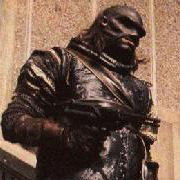
Styles' house was originally called Austerley House in Marks' scripts, becoming Alderley, Austerly, Auderley and finally Auderly House. The guards' vehicles were added at the suggestion of Jon Pertwee, who had been intrigued by the three-wheeled Honda motorcycle on display at the London Motor Show in October 1970. A more significant change was the realisation of the Daleks' footsoldiers. Referred to for much of the story's gestation as simply “Monsters”, they were initially envisaged as dog-like humanoids who spoke fluent English. It was director Paul Bernard, making his first Doctor Who serial, who suggested that they should be slow-speaking monstrous apes, and the creatures became known as Ogorons and then Ogrons. While Nicholas Courtney, John Levene and Richard Franklin had all been contracted for the entirety of Season Eight, it was decided to hire them only on a serial-by-serial basis for the new year. Franklin was the first to be contracted for Day Of The Daleks, on August 13th, followed by Courtney on August 26th and Levene on September 1st. The same would also be true of Roger Delgado, who played the Master, and would next be seen in The Sea Devils, the second serial into production for Season Nine. Jon Pertwee and Katy Manning, however, continued to be contracted for the entire season and, as such, their involvement was ensured well in advance of the other principal actors: Manning had been issued her contract for a minimum of twenty episodes on May 14th, while Pertwee's had come through on May 18th. As production loomed, Bernard learned that only three complete Daleks could be assembled from the parts retained by the BBC, some of which dated all the way back to 1963's The Daleks. They were refurbished for Day Of The Daleks, with two given a grey-and-black livery while the third was painted in gold and black to serve as the Chief Dalek. This made a change from Doctor Who's monochrome years, when the Dalek leaders had borne a predominantly black colour scheme, while the regular Daleks were grey and blue. The only new Dalek construction for Day Of The Daleks was a roughly-built skirt section, which would be used for Boaz's suicide attack in Episode Four. The paltry Dalek numbers, together with the Chief Dalek's unique colour scheme, meant that Bernard was sorely limited in planning his shots for the Dalek attack on Auderly House at the story's climax. Location filming for Day Of The Daleks started on September 13th. The original venue chosen for Auderly House was Osterley Park House in west London, but this was changed at short notice to Dropmore Park in Burnham, Buckinghamshire. Although it was then owned by the United States International University, Dropmore Park had been built in the 1790s for William Grenville, later the Prime Minister at the time of the United Kingdom's abolition of slavery. Production on September 14th started with more material at Dropmore Park, moved to Harvey House at Brentford, London, where the Doctor observed the slave labourers, and wound up near Bull's Bridge in Hayes, London, for scenes in the futuristic wasteland and at the entrance to the rebels' tunnel. Filming continued near Bull's Bridge on September 15th, before returning to Harvey House on the 16th. As usual, recording for Day Of The Daleks took place in fortnightly two-day blocks, with Mondays and Tuesdays becoming the normal studio days for Season Nine. The serial's first production block took place at BBC Television Centre Studio 4 in White City, London on October 4th and 5th. Episode One was completed on the Monday, followed by Episode Two on the Tuesday. Having viewed some of the early Dalek serials, Bernard had concluded that he disliked the effect of producing the Dalek voice using a ring modulator. Consequently, no electronic enhancement would be utilised for their dialogue in Day Of The Daleks, resulting in a very different Dalek sound. Bernard was ultimately displeased with this element of the serial, and felt that voice artistes Oliver Gilbert and Peter Messaline had not been good choices to play the Daleks. The second studio block took place on October 18th and 19th, this time in TC8. Bernard followed the same pattern as before, with Episode Three recorded on the Monday and Episode Four on the Tuesday. One notable aspect of the third installment was the inclusion of photocaptions of the First and Second Doctors -- the first visual reference to Troughton's Doctor since his final serial, 1969's The War Games, and to Hartnell's incarnation since Troughton's debut adventure, The Power Of The Daleks, in 1966. To represent the First Doctor, two images from 100,000 BC and one from The Daleks were selected, while pictures from The Faceless Ones and The Invasion depicted the Second Doctor. Jean McFarlane, who played Miss Paget, fell ill prior to the second recording block, and so her dialogue was given to Styles' aide, portrayed by extra Desmond Verini. Eliminated from Episode Four was dialogue which established that all of the Daleks infected with the Human Factor at the climax of The Evil Of The Daleks had been eradicated; hence that story was not the promised “final end” of the Daleks after all. With time running short on the 19th, Bernard opted not to record the sequel to the Episode One sequence in which the Doctor and Jo met themselves. This was intended to be the story's concluding scene, but the director thought it ended Day Of The Daleks on an anticlimactic note, much to the chagrin of Terrance Dicks. Day Of The Daleks Episode One was scheduled to begin Doctor Who's ninth season on New Year's Day 1972. During the twenty-seven weeks since the end of Season Eight, the show had largely been replaced by a documentary series called Great Zoos Of The World during the summer, and then Bruce Forsyth's Generation Game in the autumn. Doctor Who was now scheduled at 5.50pm, twenty minutes earlier than the latter part of Season Eight. Day Of The Daleks was preceded by the sitcom Whacko!, a news update and (with the exception of Episode Four) a Disney Parade cartoon short, and followed by the variety show It's Cliff Richard. Episode Two, transmitted on January 8th, garnered an audience of 10.3 million -- the first time the series had exceeded ten million viewers since part three of The Daleks' Master Plan, more than six years earlier.
|
|
|||||||||||||||||||||||||||||||||||||||||||||||||||||||||||||||||||||||||||||||||||||||||||||||||||||||||||||||||||||||||||||||||||||||||||||||||||||
| Updated 9th August 2020 |
| Return To | ||
|---|---|---|
| Main Page | Episode List | Season 9 |
| Previous Story: The Daemons | Next Story: The Curse Of Peladon |
| Next in Production: The Sea Devils |