| Previous Story: The Ark | Next Story: The Gunfighters |
|
Serial Y · Classic Series
Episodes 111 – 114: The Celestial Toymaker
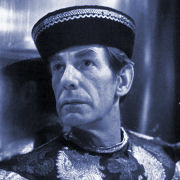
The TARDIS is taken to the surreal Celestial Toyroom by the nefarious Toymaker, an old foe of the Doctor's. Steven and Dodo are forced to play a series of games against increasingly deceitful opponents -- dolls and nursery characters, brought to life by the Toymaker -- in order to regain possession of the TARDIS. Meanwhile, the Doctor must solve the Trilogic Game in a battle of wits against the Toymaker himself. If any of the time travellers fail, they will be trapped in the Toyroom forever, transformed into playthings under the Toymaker's control.
In early 1965, writer Brian Hayles submitted a storyline to the Doctor Who production office entitled “The Dark Planet”. It was rejected on February 26th. Undaunted, Hayles developed several additional ideas for Doctor Who, of which “The Toymaker” appealed to both story editor Donald Tosh and producer John Wiles. On July 29th, Hayles was commissioned to script the first episode, for which Tosh had suggested amending the title to The Celestial Toymaker. The eponymous villain was envisioned as possibly being another member of the Doctor's race: a more malevolent version of the Monk who had appeared in The Time Meddler and The Daleks' Master Plan. Around the time that the final three installments were commissioned on September 17th, thought was given to renaming the serial “The Trilogic Game”. This element had been suggested by Tosh, and was inspired by a game called the Tower of Hanoi. Although it was actually invented in 1883 by a French mathematician called Édouard Lucas, its popular association with East Asia aligned with the intention to depict the Toymaker as wearing the garb of a Chinese mandarin. Meanwhile, Hayles had to contend with a fluctuating line-up of regular characters. Since submitting his storyline, Vicki had briefly been replaced by the Greek handmaiden Katarina, who was then to be succeeded by a sixteenth-century French orphan called Anne. It is likely that Hayles began writing for Anne, only to learn in November that the new companion would instead be Dodo, a character who would hail from modern-day England.
When Hayles delivered his scripts for The Celestial Toymaker, Wiles and Tosh realised that they would require special effects well beyond what could be achieved on the programme's budget. There were also concerns about the serial's tone, which the writer himself acknowledged had become overtly dark. However, Hayles was unable to complete the necessary rewrites due to his responsibilities to the football drama United!, which he had co-created. Instead, it was agreed that Tosh would overhaul the scripts, and the credits would identify the episodes as having been written by Tosh, from an idea by Hayles. Amongst the changes made by the story editor was the removal of a complex sequence set in a maze, to be replaced with the more straightforward game of “hunt the key”. Ever since Wiles had become the producer of Doctor Who, he had endured an adversarial relationship with William Hartnell. He and Tosh were also cognisant of their star's declining health, which was robbing him of energy in the studio and impairing his ability to accurately recall his lines. Wiles and Tosh felt that the fantastical nature of The Celestial Toymaker presented an opportunity to recast the Doctor, especially since it coincided with the expiry of Hartnell's contract. The serial had been structured so that the Doctor would be mute and mostly invisible for much of the narrative. It was suggested that, when he reappeared in the story's closing minutes, he could now be played by a different actor, who would then take over the series from Hartnell. A lingering doubt would be left in the minds of Steven and Dodo -- and the viewers -- as to whether the new character was really the Doctor, or part of another of the Toymaker's ploys. However, this scheme was soon vetoed by Wiles' superiors, and Hartnell was subsequently given a contract extension. Coming on the heels of the exhausting production of the twelve-part The Daleks' Master Plan, this contributed to Wiles' decision to quit Doctor Who around the start of January 1966. Tosh likewise opted to leave the show, and he completed his work on The Celestial Toymaker before departing on a belated honeymoon in mid-January. He was later retroactively commissioned for this work on February 16th. Wiles then made a few final modifications to the scripts, mostly to address their insufficient length, prior to handing over the producer's reins to Innes Lloyd in February. The Celestial Toymaker would feature Lloyd's first on-screen credit for Doctor Who. Soon thereafter, however, a major problem arose. A crucial elements of Hayles' storyline was the involvement of a sinister older couple, and it was decided that they should be named after the title characters of a popular 1937 play entitled George And Margaret. It had been written by Gerald Savory, who was now the BBC's Head of Serials, and had been adapted for both film and television. The twist in the tale was that, although the entire story revolved around the imminent arrival of the eponymous duo, the play ended just as they were about to appear. Hayles thought it would be amusing to finally depict George and Margaret in the flesh, but as pawns of the Toymaker who would play various games against Steven and Dodo. Both Wiles and Tosh had been very keen on this notion, and Savory's permission had been secured.
Unfortunately, less than a month before the start of production on The Celestial Toymaker, Savory had a change of heart, and instructed that George and Margaret should be excised from the serial. At this stage, director Bill Sellars had already cast Campbell Singer and Carmen Silvera as George and Margaret, and now neither Hayles nor Tosh was available for further revisions. As such, Savory gave new story editor Gerry Davis permission to undertake whatever modifications he felt were necessary to render the scripts usable. Reverting to the darker approach Hayles had initially pursued, Davis either replaced or merged George and Margaret with various pairs of characters who could be played by Singer and Silvera: the clowns Joey and Clara, the King and Queen of Hearts, and the pantomime figures of Sergeant Rugg and Mrs Wiggs. Davis also rebalanced the scripts to emphasise the experiences of Steven and Dodo over the action involving the Doctor and the Toymaker. By now, it was known that the previous serial in production, The Ark, had been very expensive, and so Davis attempted to ensure that The Celestial Toymaker could be made as cheaply as possible. Wiles was aghast at all of the changes and, on February 25th, he wrote to Savory to lament that The Celestial Toymaker had not simply been abandoned altogether. Tosh would also express his objections to the changes wrought by Davis. Filming took place on March 2nd and 3rd at the BBC Television Film Studios in Ealing, London. The material involving the Trilogic Game was a particular focus, as were the inserts which would appear in the Memory Window. Recording began on March 18th; as usual, the episodes were taped on sequential Fridays at Riverside Studio 1 in Hammersmith, London. For The Celestial Toyroom, flashbacks to earlier episodes were employed for the first time in Doctor Who. In this instance, clips of Steven from The Daleks' Master Plan and The Massacre Of St Bartholomew's Eve were screened in the Memory Window. Although there was no longer any intention to replace William Hartnell during The Celestial Toymaker, the actor was still afforded two weeks' holidays while the middle installments were in the studio. Fortunately, the relationship Hartnell was developing with Lloyd and Davis was much more cordial than with their predecessors. The latter stages of the third episode, The Dancing Floor, introduced the schoolboy Cyril. Davis had envisaged the character as being akin to the Artful Dodger, a clever young pickpocket in Charles Dickens' 1838 novel Oliver Twist. In the event, the decision was made to dress actor Peter Stephens like Billy Bunter, the beloved children's character created by Frank Richards in 1908. To reinforce the image, Stephens uttered an unscripted line of dialogue which noted that Cyril's friends call him “Billy”.
When The Celestial Toymaker began airing on April 2nd, a scheduling change that had been introduced just eight weeks earlier was reversed. This meant that Doctor Who was once again scheduled at 5.50pm, after Juke Box Jury and a news update, and before Dixon Of Dock Green. The broadcast of The Dancing Floor on April 16th elicited a complaint from the estate of Frank Richards, which expressed concern that Doctor Who was portraying Billy Bunter as an evil character. To mollify Richards' representatives, a continuity announcement was aired after The Final Test on April 23rd, emphasising that Cyril was merely imitating Billy Bunter. Following the completion of The Celestial Toymaker, the Trilogic Game prop came into the possession of Peter Purves, who was very pleased with Steven's enhanced prominence in the serial. Unfortunately, after leaving Doctor Who eight weeks later, Purves endured a year and a half with virtually no work, and he came to view the Trilogic Game as the source of his bad luck. Purves finally discarded the prop; the next day, he was offered a role on Z Cars, and soon thereafter he found himself invited to audition for a career-defining job as a presenter on the children's magazine show Blue Peter. Meanwhile, this was to prove the only appearance by Michael Gough in the role of the Toymaker. A return engagement was planned for the first story of the 1986 season, in the form of “The Nightmare Fair” by Graham Williams. Sadly, the BBC placed Doctor Who on hiatus before production began, and the original plans for the season were abandoned. The Toymaker would, however, reappear in a variety of other media, including in audio plays from Big Finish Productions, where he was voiced by David Bailie.
|
|
|||||||||||||||||||||||||||||||||||||||||||||||||||||||||||||||||||||||||||||||||||||||||||||||||||||||||||||||||||||||||||||||||||
| Updated 26th June 2024 |
| Return To | ||
|---|---|---|
| Main Page | Episode List | Season 3 |
| Previous Story: The Ark | Next Story: The Gunfighters |