| Previous Story: The Face Of Evil | Next Story: The Talons Of Weng-Chiang |
|
Serial 4R · Classic
Series Episodes 444 – 447: The Robots Of Death
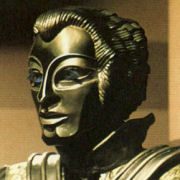
The TARDIS brings the Doctor and Leela to a Sandminer, a giant mining ship. Most of its functions are maintained by robots: the mute Dums, more advanced Vocs and highly sophisticated Super Vocs. The small human crew has little to do except sit around in idle luxury... but now they're being killed off, one by one. The lone clue to the killer's identity is a corpse marker -- normally used to denote a deactivated robot -- attached to each victim. Leela discovers a mysterious Super Voc masquerading as a Dum, while the Doctor fears that they are in the midst of a robot revolution. But is a human mind responsible?
Late in the spring of 1976, Chris Boucher was in the process of writing The Face Of Evil for Doctor Who's fourteenth season when he was asked to provide the script for the following adventure as well. This slot had originally been earmarked for The Hand Of Fear, until it was brought forward to replace Douglas Camfield's troubled “The Lost Legion” earlier in the season. Producer Philip Hinchcliffe and script editor Robert Holmes had now decided that Leela, a character introduced in The Face Of Evil, would serve as a short-term companion until the end of the year. With no time to distribute her outline to other writers, Boucher was therefore the natural choice to devise Leela's second appearance. Boucher began developing a narrative entitled “The Storm-Mine Murders”. Its starting point was Hinchcliffe's ongoing interest in a Doctor Who serial which would explore the interaction between people and robots; this had also been the goal of Season Thirteen's The Brain Of Morbius, although it ultimately evolved away from this core concept. Meanwhile, Holmes was eager for a budget-conscious storyline to help balance the anticipated expense of the season finale. He suggested a murder mystery in a confined setting, and the eventual story structure owed a debt to the iconic 1939 Agatha Christie novel best known to modern audiences as And Then There Were None. On June 22nd, Boucher was commissioned to write a storyline under the title “Planet Of The Robots”.
As with The Face Of Evil, Boucher's lifelong love of science-fiction provided much inspiration. Clifford D Simak's 1950 short story Bathe Your Bearings In Blood! (also known as Skirmish) suggested the element of an outside influence inciting a robot rebellion. The axioms which held the robots in check were reminiscent of the Laws of Robotics created by Isaac Asimov, beginning with the 1941 short story Liar! (which was later included in the seminal I, Robot). The Sandminer itself drew upon elements of Frank Herbert's classic Dune novels, published from 1963. Boucher acknowledged his sources by littering “Planet Of The Robots” with namechecks for well-known science-fiction writers: Uvanov was a corruption of “Asimov”, Poul was a reference to Tau Zero author Poul Anderson, and Taren Capel was an homage to Karel Čapek, who first coined the term “robot” in his 1921 play RUR (Rossum's Universal Robots). Boucher's scripts were requested on July 20th. Around mid-September, the serial was renamed The Robots Of Death. Later that month, production assistant Peter Grimwade discovered that Episode Two was severely underrunning. As a result, material about the Sandminer's overloading motive units was added to its closing stages; it appears that the cliffhanger had originally centred on the murder of Zilda. The director assigned to The Robots Of Death was Michael E Briant, whose most recent Doctor Who work had been on 1975's Revenge Of The Cybermen. Briant was reluctant to return to the series -- in fact, this would be his sixth and final serial -- and, having made the commitment, found himself unhappy with Boucher's scripts. As a result, Briant resolved to enhance The Robots Of Death with strong visual elements, and he worked closely with designer Ken Sharp and costume designer Elizabeth Waller to conceive a distinctive art deco look. Amongst the cast was Pamela Salem, playing Toos. She had unsuccessfully auditioned for the role of Leela, but had made a good impression on the Doctor Who production team. Meanwhile, Hinchcliffe had been contemplating leaving Doctor Who at the end of the season, and Holmes considered following suit. However, when Head of Serials Bill Slater asked Hinchcliffe to remain for a fourth year, he agreed. The production team duly set to work coming up with ideas for Season Fifteen, such as a new alien race with smooth silicon skin. Stories being planned included an historical adventure (featuring a love interest for Leela), one set on a generation-spanning vessel (which was an idea Boucher had pursued during the development of The Face Of Evil), a London-based tale in which an immense spaceship arrived in the skies above the city, a story inspired by the works of H Rider Haggard (author of King Solomon's Mines and She), and another based upon Joseph Conrad's 1899 novel Heart Of Darkness (which was to be written by Holmes).
During the autumn, however, the decision to extend Hinchliffe's tenure was reevaluated. Although he had guided Doctor Who to audience numbers that were unprecedented in their consistency, he had frequently been a target of critics who argued that the programme now depicted too much horror and violence. Meanwhile, newly-promoted BBC producer Graham Williams was developing two series: a hard-hitting police drama named Hackett and an American co-production called The Zodiac Factor. In October, The Zodiac Factor ran into problems and, around the start of November, it was decided to move Williams onto Doctor Who. In turn, Hinchcliffe would take over Hackett, which was now deemed to be a better fit for his edgy style; he would redevelop it as Target. The Robots Of Death entered production around the same time, with filming taking place at the BBC Television Film Studios in Ealing, London. Model shots were completed on November 2nd and 4th; the 5th was also kept in reserve in case more time was needed. Some of this material was directed by Grimwade, who would later become a fully-fledged Doctor Who director beginning with Full Circle in 1980. On November 3rd, Briant recorded the Episode One cliffhanger in which the Doctor was buried alive in the Sandminer hopper. Baker disliked its resolution, which required SV7 to rescue the Doctor, and instead suggested an action-packed sequence in which the Doctor swung on his scarf to kick the door open. He and the director argued vociferously until Briant revealed that Graham Williams was present to observe the shoot. Baker quickly agreed to follow the scripted instructions. Studio work for The Robots Of Death was divided into a two-day session and a three-day session. As he had done on past Doctor Who serials, Briant opted to use the first day of each block solely for camera rehearsals. As such, the only recording for the first session took place on November 23rd, at BBC Television Centre Studio 8 in White City, London. Most of Episodes One and Two was taped, alongside Episode Three material in the crew room and Uvanov's office. Although no one could have realised it at the time, this day marked the final use of the wooden TARDIS console room set which had been introduced at the start of the season, in The Masque Of Mandragora. It was not required for the next adventure, The Talons Of Weng-Chiang, and the wood became damp and warped in storage during the months before Season Fifteen started shooting. As such, it would have to be replaced.
Production on The Robots Of Death wrapped up in TC1 on December 6th and 7th. On the first day, Briant concentrated on sequences for Episode Three, as well as scenes on the control deck for Episode Two and in Toos' cabin for Episode Four. Baker and Gregory de Polnay, who played D84, developed a very good working relationship, to the point that de Polnay became hopeful that D84 might be saved and made a regular companion. The last day principally dealt with material from the concluding installment. Also completed was footage in the workroom for Episode Three, plus sequences in the silo, the dust scoop and the control room which required the chroma key effects technique. During recording, Baker changed the scripted mention of “Grimwol's Syndrome” to “Grimwade's Syndrome” in reference to the production assistant. Unfortunately, this session was fraught with problems and delays, largely stemming from repairs which had to be made when several sets were found to have incurred significant damage. At one point, The Robots Of Death was planned to debut on January 1st, 1977, following a one-week Christmas break. When the hiatus was extended to five weeks and The Face Of Evil was correspondingly delayed, the broadcast of Episode One was instead shifted to January 29th. Ahead of the serial's transmission, some press reports suggested that Salem was joining Doctor Who as another new companion. In fact, however, these stories were contrived by the actress' publicist; there had never been any intent to retain Toos beyond The Robots Of Death.
|
|
|||||||||||||||||||||||||||||||||||||||||||||||||||||||||||||||||||||||||||||||||||||||||||||||||||||||||||||||||||||||||||||||||||
| Updated 11th January 2021 |
| Return To | ||
|---|---|---|
| Main Page | Episode List | Season 14 |
| Previous Story: The Face Of Evil | Next Story: The Talons Of Weng-Chiang |