Serial 6A · Classic
Series Episodes 570 & 571:
Black Orchid
In 1925 England, a case of mistaken identity leads the Doctor to join a
charity cricket match organised by the wealthy Cranleigh family. Nyssa
discovers that Lord Charles Cranleigh's fiancee, Ann Talbot, is her
exact double. Enchanted with the time travellers, the Cranleighs invite
them to a masquerade ball that evening. There, Tegan learns of the
tragic loss of Charles' elder brother, George, on a botanical expedition
to South America. Meanwhile, the Doctor discovers a dead body hidden
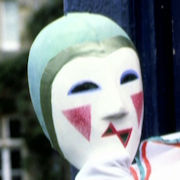
beyond a secret passageway. Having stolen the Doctor's harlequin
costume, the killer now stalks the party, intent on Ann.
When he became Doctor Who's producer at the end of 1979, John
Nathan-Turner decided to dispense with six-part stories, which he felt
were too long to hold viewers' interest. For Season Eighteen, he secured
a budget for twenty-eight episodes -- two more than had previously been
the norm -- so that the year could be comprised solely of seven
four-part serials. The same approach was originally intended for Season
Nineteen as well. Around the start of 1981, however, Nathan-Turner
decided to repurpose the budget for two episodes in order to make A Girl's Best Friend, a one-hour pilot
for a proposed K·9 And Company spin-off series. As such,
Season Nineteen would instead feature Doctor Who's first two-part
adventure since The Sontaran Experiment in
1975.
To fill this slot, Nathan-Turner revived a proposal called “The
Beast”, which Terence Dudley had discussed with script editor
Christopher H Bidmead circa the previous August. A murder-mystery based
on ideas Dudley had originally developed for another programme,
“The Beast” had been rejected by Bidmead because it did not
fit the mould of strong, science-based narratives that he and
Nathan-Turner were seeking. Dudley instead scripted Four To Doomsday but, following Bidmead's
departure from Doctor Who at the end of 1980, Nathan-Turner
decided to revisit “The Beast”, towards which he felt more
enthusiasm. He disliked the title, however, and so it was commissioned
as Black Orchid on February 9th.
Black Orchid was the first
Doctor Who story without any science-fiction
trappings since 1967
One element of Dudley's narrative that Nathan-Turner appreciated was the
spotlight it cast on Nyssa. Other Season Nineteen stories were already
focussing on her fellow companions, with Tegan crucial to Kinda and Adric meeting his doom in “The Enemy Within”
(later replaced by Earthshock). With
Doctor Who now boasting so many regular characters, the producer
felt that this approach would help the audience relate to each one
individually. Nathan-Turner was also keen on the fact that Black
Orchid would be the first Doctor Who story without any
science-fiction trappings whatsoever since The
Highlanders in 1967.
For a time, Nathan-Turner considered directing Black Orchid
himself; of Doctor Who's previous producers, Barry Letts had
directed several serials during the early Seventies, while Graham
Williams had been pressed into emergency service on 1979's Nightmare Of Eden. By the summer, however, it
was clear that Nathan-Turner's combined workload on the remainder of the
Season Nineteen and K·9 And Company would preclude this
possibility. John Black -- who had just completed Four To Doomsday -- was then considered for
Black Orchid. But Black was also assigned to direct A Girl's Best Friend and, since it would
go into production soon after Black Orchid, it was agreed that he
could not feasibly work on both. Finally, it was decided that the
brevity of Black Orchid made it an excellent project for a novice
director. The task went to Ron Jones, an acquaintance of Nathan-Turner's
from his days as a production unit manager.
Jones' first order of business would be location filming, primarily for
the scenes outside Dalton Hall. Various manor houses were considered,
but the eventual choice was suggested by the production of Castrovalva, which had been recorded
immediately before Black Orchid. Much of its location work had
taken place on the grounds of Buckhurst Park in Withyam, East Sussex,
and the cast and crew had been warmly welcomed by the estate's owner,
Earl De La Warr. In late September, Nathan-Turner approached the Earl
about using the main residence at Buckhurst Park as Dalton Hall. The
Earl was less eager to feature the house itself in Doctor Who,
but he ultimately consented on the condition that personal photography
was strictly controlled.
First, however, Jones' team spent October 5th at Quainton in
Buckinghamshire. The roadway material was filmed on Quainton Road, while
the police station was actually an abandoned house on the same
thoroughfare. Cranleigh Halt was in fact the Quainton Road Railway
Station, which had been closed in 1963. Although Jones planned his shots
to keep Nyssa and Ann Talbot from appearing together as much as
possible, this was not always feasible. Vanessa Paine was therefore
hired to double as either Nyssa or Ann, as appropriate -- although Sarah
Sutton was disappointed that the actress did not resemble her more
closely.
The next four days were spent at Buckhurst Park. On October 6th, the
stunt in which George Cranleigh plummetted off the roof went awry:
stuntman Gareth Milne missed his cushioned target and struck the ground
with his legs, although he escaped injury. The dance sequences were the
main focus on the 7th and 8th, much to the delight of Sutton and Janet
Fielding. Matthew Waterhouse was less enthusiastic; he suggested that
Adric should be more interested in the food, so that he would not have
to participate in the choreography. October 9th was devoted to the
cricket match, which was staged at a pitch used by the Withyam Cricket
Club, on the grounds of Buckhurst Park.
Black Orchid was accorded just two studio days: October 20th and
21st, at BBC Television Centre Studio 3 in White City, London. The first
day dealt with all of the material in the TARDIS, Nyssa and Tegan's
guest bedroom, the secret corridor and the small annex. Jones also
recorded some scenes in the drawing room, George's cell and the landing.
He completed this work on the second day, together with sequences on the
stairs, in the Doctor's guest bedroom, and in Ann's room.
Unfortunately, taping on the 21st was badly delayed due to industrial
action by the electricians' union. Although Jones worked quickly and
Nathan-Turner authorised a costly one-hour overrun, two scenes in Ann's
bedroom -- in which George spied on his former fiancee -- had to be
abandoned. Jones subsequently tried to repair the damage by using shots
of George which had been recorded the previous day. Nonetheless,
Nathan-Turner was impressed by how Jones had handled such difficult
circumstances. He was immediately offered the season finale, Time-Flight, which had just lost its intended
director.
- Doctor Who Magazine #298, 13th December 2000, “Archive:
Black Orchid” by Andrew Pixley, Panini Publishing Ltd.
- Doctor Who Magazine Special Edition #1, 2001, “Prince
Charming” by Andrew Pixley, Panini Publishing Ltd.
- Doctor Who: The Complete History #35, 2018, “Story 120:
Black Orchid”, edited by John Ainsworth, Hachette Partworks
Ltd.
- Doctor Who: The Eighties by David J Howe, Mark Stammers and
Stephen James Walker (1996), Virgin Publishing.
- Doctor Who: The Handbook: The Fifth Doctor by David J Howe
and Stephen James Walker (1995), Virgin Publishing.
- In·Vision #59, August 1995, “Production”
edited by Anthony Brown, Cybermark Services.
|
|
Original Transmission
|
|
| Episode 1 |
| Date |
1st Mar 1982 |
| Time |
6.57pm |
| Duration |
24'56" |
| Viewers (more) |
9.9m (57th) |
| Episode 2 |
| Date |
2nd Mar 1982 |
| Time |
7.04pm |
| Duration |
24'41" |
| Viewers (more) |
10.1m (55th) |
Cast
| The Doctor |
| Peter Davison (bio) |
| Adric |
| Matthew Waterhouse (bio) |
| Nyssa |
| Sarah Sutton (bio) |
| Tegan |
| Janet Fielding (bio) |
| Ann |
| Sarah Sutton (bio) |
| Lady Cranleigh |
| Barbara Murray |
| Sir Robert Muir |
| Moray Watson |
| Lord Cranleigh |
| Michael Cochrane |
| Brewster |
| Brian Hawksley |
| Tanner |
| Timothy Block |
| Latoni |
| Ahmed Khalil |
| Charles Cranleigh |
| Gareth Milne |
| Sergeant Markham |
| Ivor Salter |
| Constable Cummings |
| Andrew Tourell |
Crew
| Written by |
| Terence Dudley (bio) |
| Directed by |
| Ron Jones (bio) |
|
| Incidental Music |
| Roger Limb |
| Special Sound |
| Dick Mills |
| Production Manager |
| Jim Capper |
| Production Associate |
| Angela Smith |
| Production Assistant |
| Juley Harding |
| Assistant Floor Manager |
| Val McCrimmon |
| Film Cameraman |
| Peter Chapman |
| Film Sound |
| Ron Blight |
| Film Editor |
| Mike Houghton |
| Visual Effects Designer |
| Tony Auger |
| Video Effects |
| Dave Chapman |
| Vision Mixer |
| Carol Johnson |
| Technical Manager |
| Alan Jeffery |
| Senior Cameraman |
| Alec Wheal |
| Videotape Editor |
| Rod Waldron |
| Studio Lighting |
| Fred Wright |
| Studio Sound |
| Alan Machin |
| Costume Designer |
| Rosalind Ebbutt |
| Make-Up Artist |
| Lisa Westcott |
| Script Editor |
| Eric Saward (bio) |
| Title Sequence |
| Sid Sutton |
| Designer |
| Tony Burrough |
| Producer |
| John Nathan-Turner (bio) |
|