| Previous Story: The Savages | Next Story: The Smugglers |
|
Serial BB · Classic
Series Episodes 123 – 126: The War Machines
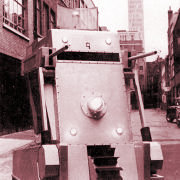
Arriving in 1966 London, the Doctor feels that something is wrong in the newly-completed Post Office Tower. He and Dodo learn that it houses WOTAN (Will Operating Thought ANalogue), which is designed to link up with other computers worldwide. But WOTAN has become sentient, and has determined that humanity must be subjugated. WOTAN takes hypnotic control of its creators, and directs them to initiate the construction of armed mobile computers called War Machines. Aware of the threat posed by the time travellers, WOTAN also brainwashes Dodo, with the intention of using her to lure the Doctor into a trap...
Upon assuming the reins of Doctor Who in early 1966, one of the first decisions made by producer Innes Lloyd and story editor Gerry Davis was to gradually eliminate adventures set in Earth's history. They felt that viewers had become disinterested in these serials, and audience figures appeared to support their position. Instead, Lloyd and Davis decided to tell more more stories on contemporary Earth; to date, the TARDIS had landed in the present day only under unusual circumstances (such as when the time travellers were miniaturised in 1964's Planet Of Giants) or for fleeting moments (as in 1965's The Chase and The Daleks' Master Plan). The production team also wanted to ground Doctor Who more firmly in reality and scientific fact. To this end, Davis began interviewing a number of noted scientists in search of someone who could provide creative advice. He had unproductive discussions with gerontologist Dr Alex Comfort (later the author of The Joy Of Sex), electrical engineer Eric Laithwaite of Imperial College, and astronomer Patrick Moore (host of The Sky At Night). Finally, Davis met with Dr Kit Pedler, a researcher with the University of London who specialised in the retina.
Visible from Davis' office was the General Post Office Tower in Fitzrovia, London. The centre of the United Kingdom's telecommunications network, the Tower had been built between 1961 and 1964, and was officially opened by Prime Minister Harold Wilson on October 8th, 1965. The tallest building in the country, it was scheduled to hold its public opening in May. As a means of gauging Pedler's suitability for Doctor Who, Davis asked him to imagine what might happen if the Post Office Tower took over; it was a question he had posed to previous candidates, eliciting only unimaginative responses. Pedler, however, immediately suggested that such an event might be perpetrated by a rogue computer. Immobile inside the Tower, it would act via the telephone and through robotic agents. In the wake of this meeting, Lloyd and Davis had not only found their “scientific adviser”, but also had the premise for a new storyline, which was further fleshed out by Davis. BBC staff writer Pat Dunlop was then tasked with expanding the storyline, now called “The Computers”, into a full script. After writing a draft of the first episode, however, Dunlop asked to be removed from the assignment so that he could take up the post of script consultant on Dixon Of Dock Green. Davis instead invited Ian Stuart Black to step into the breach. Black had just completed The Savages, the story which would precede “The Computers”; he was commissioned on March 15th. In late March, Black began delivering his scripts under the title The War Machines; some documentation would also refer to it as “The War Of The Machines”. It was Black's intention that those under WOTAN's thrall would be discernible because their hands would take on a skeletal aspect -- forcing characters like Dodo and Professor Brett to wear gloves to hide this mark. Sir Charles Summer's first name was initially Robert, while journalist Roy Stone's surname had been Pails. The tramp killed in the warehouse was originally an Australian tourist. Black's scripts also introduced a new companion called Richard (or “Rich”) to replace Steven Taylor, who had been written out in The Savages. As The War Machines was originally envisaged, Dodo and Rich met at the Inferno nightclub, where they were hostile and then flirtatious towards each other. When the Doctor discovered that Dodo had been hypnotised by WOTAN, she fled and returned to the computer. Later, Rich found her working in a warehouse to build War Machines, and she facilitated his escape. Rich then stowed away aboard the TARDIS at the end of the adventure, joining the Doctor and Dodo in their travels. By mid-April, however, Lloyd and Davis had decided to make a clean sweep of companions, and Jackie Lane's contract was extended only up to the second episode of “The Computers”. The imminent exit of both Steven and Dodo from Doctor Who was revealed to the public on April 26th. Fearing that Doctor Who was in danger of appearing outdated, Lloyd and Davis were keen to introduce characters who would be more hip and in tune with the Swinging Sixties. Ben Jackson -- as Rich had been renamed -- was already designed to fit this mould, and it was thought that a young adult woman would complement him better than the typical teenaged girl previously favoured by Doctor Who. As such, Lloyd and Davis created Dodo's replacement, Polly; her intended surname, Wright, was never revealed on screen.
Black was asked to amend his scripts to write out Dodo and have both Ben and Polly join the Doctor at the story's conclusion. It was now Polly, rather than Dodo, who would develop a camaraderie with Ben at the Inferno. The Doctor cured the brainwashed Dodo in Episode Two, after which she was despatched to the countryside to recover, providing the character's exit. Polly then assumed Dodo's role for the second half of the adventure. The role of Polly went to Anneke Wills, whom the production team had met some weeks earlier when her husband, Michael Gough, played the titular villain in The Celestial Toymaker. Gough's enjoyment of his time on Doctor Who contributed to Wills' decision to accept the part, although she was warned that William Hartnell was growing increasingly difficult to work with. Cast as Ben was Michael Craze, whose brother, Peter, had been in The Space Museum the previous season. Frazer Hines also vied for the part, and would instead be cast as Jamie McCrimmon several months later. Both Wills and Craze were signed for four serials, she on May 25th and he a day later. A photocall for the two new regulars was held on June 23rd. The director appointed to The War Machines was Michael Ferguson who, two years earlier, had been an assistant floor manager on The Daleks. Filming began on May 22nd. This day was spent at various London locations -- although, unfortunately, not at the Tower itself. On May 5th, the Post Office had informed Ferguson that they were unable to provide access to the Doctor Who team, for fear of interfering with the building's public opening. The TARDIS materialised at Bedford Square in Bloomsbury, where the exterior of the Royal Scientific Club was also located. The phone booth attacked by a War Machine was at Charlotte Place in Fitzrovia, and it ran through the garbage bins on Gresse Street. Other street scenes were captured on Berners Mews, Maple Street and Conway Street, all in Fitzrovia near the Post Office Tower. This was followed by three days at the BBC Television Film Studios in Ealing, London. May 23rd and 24th concentrated on sequences at the warehouse where the War Machines were constructed. The Ealing backlot was used on May 25th for material at the market. May 26th saw the team head back out on location to various London venues. The Doctor captured the War Machine at Cornwall Gardens in Kensington, while street scenes involving Ben were performed at Covent Garden Market and Bow Street in Covent Garden. Studio work then began on June 10th; as usual, each episode was taped on consecutive Fridays at Riverside Studio 1 in Hammersmith, London. In the interim, the TARDIS prop underwent its first major refurbishment. This work included a paint job, for which the St John Ambulance badge on the door -- which had become increasingly obscured -- was removed and never replaced. It would not return to the police box exterior until 2010. For the first time, each installment of The War Machines began with a special animation sequence, designed by Bernard Lodge, to announce the title, author and episode number. This was a practice which would be employed sporadically over the next few years. June 17th marked Jackie Lane's final involvement in Doctor Who. On the 20th, Lloyd sent her a letter apologising for the fact that she had become “a victim of circumstance” and wishing her well for the future. Meanwhile, William Hartnell was having difficulty adapting to his new castmates. Although he tried to make Wills and Craze feel welcome on Doctor Who, they both approached their acting in ways that were very different from Hartnell. The leading man's health had also been in significant decline in recent months. Hartnell was now more physically frail, and his memory had deteriorated to the point that remembering lines was becoming a substantial challenge. All of these factors impacted Hartnell's mood, making him appear frustrated and combative.
Summer events played havoc with the BBC schedules throughout the broadcast of The War Machines. On June 25th, Episode One did not lead into The Munsters as usual; instead, highlights from the Wimbledon tennis tournament aired after the news and weather. On July 2nd, the same event pushed Episode Two back in the schedule by eighty minutes, to 6.55pm. It was preceded by Summer Grandstand and the news update, and followed by the 1947 Western movie Ramrod. Things were more normal for the broadcast of Episode Three on July 9th, except Quick Before They Catch Us had now moved into the timeslot after Doctor Who, swapping places with The Munsters. On July 16th, the final installment of The War Machines moved into the spot normally occupied by Juke Box Jury, directly after Grandstand, in order to accommodate highlights from the Royal Tournament later in the evening. The War Machines part four also served as the finale for Doctor Who's third season; the production block would continue for another serial, with The Smugglers held over to start Season Four in September. Meanwhile, Innes Lloyd had finally received permission to replace William Hartnell with a new actor. Lloyd's predecessor, John Wiles, had attempted this months earlier, only to face opposition from his BBC superiors. Now, however, Hartnell's health and behaviour had declined to the point that Lloyd's argument was sufficiently convincing. As the screen went dark on Season Three, viewers could have little sense of how much the face of Doctor Who was about to change, forever...
|
|
||||||||||||||||||||||||||||||||||||||||||||||||||||||||||||||||||||||||||||||||||||||||||||||||||||||||||||||||||||||||||||||||||||||||||||||||||||||||
| Updated 25th July 2023 |
| Return To | ||
|---|---|---|
| Main Page | Episode List | Season 3 |
| Previous Story: The Savages | Next Story: The Smugglers |